
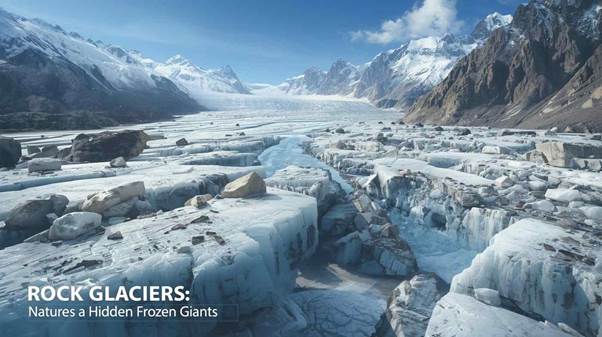
High in the world’s mountains, where ice and rock meet, lies one of the most fascinating geological features Rock glaciers. Unlike traditional glaciers made purely of ice, rock glaciers are mixtures of ice, rock, debris, and sediment that slowly flow downslope under the influence of gravity.
Table of Contents
They resemble frozen rivers of boulders, but beneath their rocky surface lies a hidden core of ice. These formations play a vital role in alpine ecosystems, water storage, and climate research. Despite their importance, they often go unnoticed, overshadowed by their larger ice glacier counterparts.
As climate change reshapes cold environments, understanding Rock glaciers has become more urgent. They are not just geological curiosities; they are active reservoirs of frozen water and powerful indicators of environmental change.
What Are Rock Glaciers?
Rock glaciers are bodies of permafrost rich in ice, covered by a thick layer of rock debris that protects the underlying ice from melting. They can range from a few hundred meters to several kilometers in length. While they may appear like rocky slopes, their movement patterns and internal ice composition distinguish them from simple landslides or rockfalls.
Related Article: Glacier Retreat: Causes, Consequences, and Global Impact
Their slow creep, often only a few centimeters to meters per year, is driven by the deformation of ice within the glacier or by frost creep in the permafrost. This makes them dynamic, living landscapes that shape high-altitude terrain.
Formation of Rock Glaciers
The creation of Rock glaciers requires a combination of specific geological and climatic conditions:
- Cold temperatures that allow permafrost to form and remain stable.
- Rockfall or debris accumulation from nearby cliffs, which covers and insulates the ice.
- Moisture supply, often from snow or ice melt, that contributes to the frozen core.
- Gravity-driven flow that causes the mass to move downslope.
Over centuries, these processes combine to produce massive, creeping bodies of frozen rock and ice that can outlast traditional glaciers.
Types of Rock Glaciers
Scientists classify Rock glaciers into two main categories based on their structure and activity:
- Ice-cored rock glaciers: Formed when debris covers an existing glacier, protecting its ice from melting.
- Permafrost rock glaciers: Created from the freezing of groundwater and snow in debris fields, with ice forming between rock fragments.
Both types share similar outward appearances, but their origins highlight the diverse ways in which ice and rock interact in alpine regions.
Distribution Around the World
Rock glaciers are common in mountain ranges across the globe. They are found in the European Alps, the Andes, the Rocky Mountains, the Himalayas, and even in polar regions such as Alaska and Greenland. In arid mountain regions, such as the Andes, rock glaciers often serve as vital water sources for local communities during dry seasons.
The global distribution of rock glaciers underscores their ecological significance and their role in linking geology, hydrology, and climate.
Ecological and Hydrological Importance
Beyond their striking appearance, Rock glaciers are critical to mountain ecosystems. Their ice cores act as natural reservoirs, slowly releasing water during warmer months. In regions where water scarcity is a major challenge, rock glaciers help regulate streamflow and sustain agriculture, wildlife, and human settlements.
They also stabilize mountain slopes by binding rock and ice together, reducing the risk of massive rockfalls. However, as they thaw due to rising global temperatures, their stabilizing effect weakens, leading to increased landslide risks.
Rock Glaciers as Climate Indicators
One of the most valuable aspects of Rock glaciers is their role as indicators of climate change. Because they are sensitive to temperature fluctuations, their movement and stability provide insights into permafrost dynamics. Scientists use them to study long-term changes in mountain permafrost and to predict the impacts of global warming.
In some cases, inactive or relict rock glaciers those no longer containing ice serve as records of past climate conditions, offering a geological archive of how mountain environments have changed over millennia.
Human and Environmental Impacts
As climate change accelerates, Rock glaciers face increasing stress. Melting of their ice cores can destabilize slopes, posing hazards to infrastructure, roads, and communities in mountainous regions. At the same time, the loss of these frozen reservoirs threatens water supplies in arid mountain valleys dependent on meltwater.
Mining activities in high-altitude areas also endanger rock glaciers. Blasting, excavation, and changes in hydrology can accelerate melting, undermining both water security and slope stability. This has raised debates in countries like Chile and Argentina, where rock glaciers are legally protected as critical water sources.
Studying and Monitoring Rock Glaciers
To better understand Rock glaciers, scientists employ a range of tools:
- Remote sensing through satellite imagery to map distribution and movement.
- Geophysical surveys such as ground-penetrating radar to measure internal ice content.
- GPS monitoring to track their slow downslope creep.
- Climate modeling to assess how warming will affect their longevity.
These studies not only improve scientific knowledge but also inform policies to protect vulnerable mountain environments.
The Future of Rock Glaciers
The outlook for Rock glaciers is closely tied to global warming. As temperatures rise, many are expected to shrink or disappear over the coming centuries. Yet, their rocky coverings provide some insulation, making them more resilient than pure ice glaciers. This means that in many mountain regions, rock glaciers may outlast traditional glaciers, serving as one of the last remaining sources of frozen water.By preserving and studying rock glaciers, humanity gains both a water resource and a natural climate archive.
Conclusion
Rock glaciers are more than frozen piles of rock and ice; they are dynamic, vital components of mountain landscapes. From storing water and stabilizing slopes to serving as climate indicators, they embody the interconnectedness of geology, ecology, and climate science. As the planet warms, their importance becomes even clearer both as resources and as warning signals of environmental change.
Protecting Rock glaciers is not just about preserving geological features. It is about securing water supplies, safeguarding mountain communities, and respecting the delicate balance of high-altitude ecosystems..
1 Comment
Add Yours →[…] Related article: Rock Glaciers: Nature’s Hidden Frozen Giants […]