
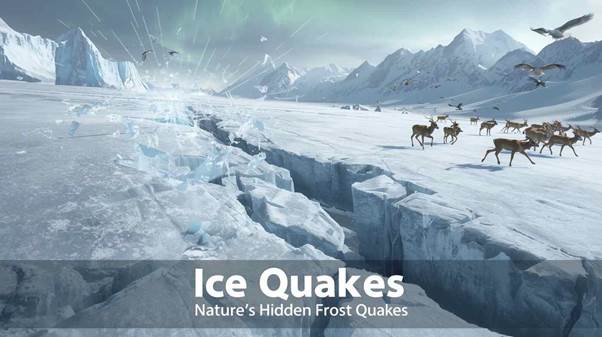
In the coldest corners of our planet, winter often brings with it an unusual natural event known as Ice quakes. Unlike traditional earthquakes caused by shifting tectonic plates, ice quakes or cryoseisms occur when water trapped beneath or within ice rapidly freezes and expands.
This sudden expansion produces sharp cracking sounds and vibrations, sometimes strong enough to rattle windows, shake the ground, or even mimic the effects of minor earthquakes. While still relatively rare, Ice quakes are becoming more common in certain regions due to shifting climate patterns and extreme cold events.
Understanding the science, causes, and impacts of ice quakes not only satisfies curiosity but also helps communities prepare for these dramatic natural phenomena.
What Are Ice Quakes?
Ice quakes are seismic-like events triggered by the rapid freezing of water-saturated ground or ice layers. When temperatures suddenly plunge, the moisture trapped underground expands as it turns into ice. Because water expands by nearly 9% when frozen, this generates intense pressure on surrounding soil and rock. Eventually, the pressure exceeds the ground’s strength, leading to a sudden rupture accompanied by a loud boom and tremor.
Although they share similarities with earthquakes, ice quakes are distinct because they occur near the Earth’s surface and are linked to freezing conditions rather than tectonic activity. Typically, they measure low on the seismic scale usually below magnitude 2.0—yet the startling sounds and vibrations they produce can alarm residents who mistake them for explosions or earthquakes.
Conditions That Trigger Ice Quakes
The occurrence of Ice quakes depends on a unique set of conditions:
- Sudden temperature drops: When temperatures plummet rapidly, especially after a thaw, groundwater freezes quickly and creates stress.
- Water saturation: Areas with high groundwater levels or moist soil are more prone to ice quakes.
- Frost depth: When frost penetrates deeply into the ground, water trapped at lower layers freezes abruptly, creating ruptures.
- Seasonal extremes: Ice quakes are most common during late autumn or mid-winter when fluctuating weather patterns set the stage for rapid freezing.
These conditions explain why Ice quakes are frequently reported in regions such as Canada, the northern United States, Scandinavia, and other cold-weather zones.
How Ice Quakes Differ from Earthquakes
Although both produce ground shaking and audible noises, Ice quakes differ from earthquakes in several key ways:
- Cause: Ice quakes are caused by freezing water, whereas earthquakes stem from tectonic plate movements.
- Depth: Ice quakes occur near the surface, while earthquakes originate deep underground.
- Magnitude: Earthquakes can reach catastrophic magnitudes, but ice quakes are usually minor, rarely causing structural damage.
- Duration: Ice quakes are short-lived, often lasting just seconds.
Despite these differences, many first-time witnesses confuse the booming sounds of Ice quakes with gunshots, explosions, or minor seismic activity.
Ecological and Environmental Impacts
While generally harmless compared to earthquakes, Ice quakes can still impact ecosystems and infrastructure. The sudden cracking of frozen ground may damage roads, pipelines, and underground utilities in regions prone to extreme cold. On lakes or rivers, ice quakes can cause dangerous fissures in ice sheets, posing risks to winter sports enthusiasts and local wildlife.From an environmental perspective, the study of Ice quakes provides valuable insights into the effects of climate variability.
Human Experiences of Ice Quakes
For communities in northern climates, Ice quakes are both fascinating and unsettling. Many residents describe them as sounding like a cannon blast or a thunderclap beneath the ground. At night, when ambient noise levels are lower, these sudden booms can startle people awake. While they rarely cause significant property damage, the psychological impact can be strong, as people often fear earthquakes or explosions before learning the true cause.
Local news outlets in cold regions often report spikes in calls to emergency services during episodes of Ice quakes, especially when multiple tremors occur over a single night.
Ice Quakes and Climate Change
Climate change may influence the frequency of Ice quakes. Warmer winters followed by sharp cold snaps create conditions that favor freeze-thaw cycles, leading to more ice pressure build-up underground. Areas that historically experienced stable cold may now face fluctuating patterns, increasing the likelihood of these frost quakes.Scientists are beginning to study Ice quakes not just as geological curiosities but as indicators of broader environmental changes.
Preparing for Ice Quakes
While unpredictable, Ice quakes pose little danger compared to other natural disasters. Still, there are measures individuals and communities can take:
- Awareness campaigns: Educating residents helps reduce panic when loud booms or vibrations occur.
- Infrastructure monitoring: Cold-region engineers can design utilities and pipelines with flexibility to withstand frost pressure.
- Emergency response readiness: Local authorities can prepare to reassure the public and address minor damages when Ice quakes strike.
Preparation ensures that these natural events remain a source of intrigue rather than alarm.
The Scientific Importance of Ice Quakes
For researchers, Ice quakes present an opportunity to study cryoseismic activity and its connection to hydrology and climate science. Seismographs often detect these small events, helping scientists distinguish between tectonic and cryogenic seismicity. By mapping patterns of Ice quakes, scientists can better understand soil composition, groundwater levels, and freeze dynamics in cold regions.
Furthermore, studying these events in polar areas such as Greenland and Antarctica provides insight into ice sheet dynamics and glacial movements. Thus, Ice quakes contribute not only to local awareness but also to global scientific research.
Conclusion
Ice quakes are one of nature’s most striking cold-weather phenomena, blending geology, climate, and human experience into a single event. Caused by rapid freezing of groundwater, they produce loud booms and tremors that both fascinate and alarm those who encounter them. While less destructive than earthquakes, they carry environmental and infrastructural significance and offer scientists valuable clues about seasonal and climate patterns.
As winters continue to change under the influence of global warming, the occurrence of Ice quakes may become more common in regions unaccustomed to them. By studying, monitoring, and preparing for these frost quakes, communities can transform fear into understanding embracing them as reminders of the planet’s powerful natural processes.