
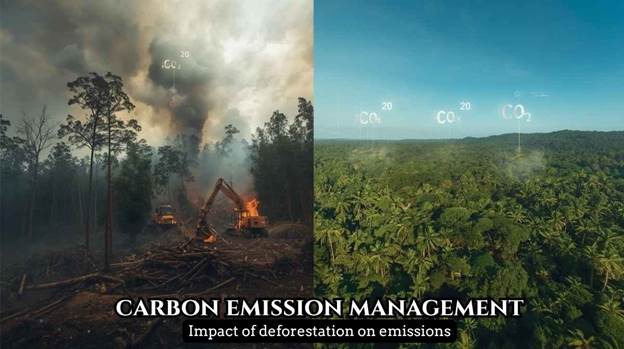
Carbon emission management has become one of the most urgent global priorities as nations strive to combat climate change. Among the many factors contributing to greenhouse gases, deforestation stands out as a leading driver of emissions. Forests act as natural carbon sinks, absorbing vast amounts of carbon dioxide from the atmosphere. When they are cut down or burned, not only is this absorption lost, but the stored carbon is also released, dramatically increasing emissions.
Table of Contents
This article explores how deforestation contributes to rising emissions, its history and significance, challenges in carbon emission management, and real-world examples of both the problem and potential solutions.
Understanding Deforestation and Carbon Emission Management
Deforestation refers to the large-scale removal of forests, often for agriculture, urbanization, or logging. In the context of carbon emission management, deforestation represents a double threat. First, it removes trees that absorb carbon dioxide. Second, it releases stored carbon into the atmosphere through burning or decay.
Key impacts of deforestation on emissions include:
• Rising levels of carbon dioxide in the atmosphere
• Loss of carbon sequestration capacity
• Greater vulnerability to climate change-related disasters
By understanding these links, governments and organizations can develop more effective carbon emission management strategies.
Historical Background: Forests and Climate Balance
Historically, forests have played a vital role in maintaining Earth’s climate balance. Ancient civilizations relied on forest ecosystems, but large-scale deforestation accelerated during industrial expansion in the 18th and 19th centuries. With rapid agricultural development and urban sprawl in the 20th century, global deforestation reached alarming levels.
Economic and Environmental Importance of Forests
Forests are more than just natural landscapes; they are critical assets in global emission control. Their importance can be understood in several dimensions:
Role in Climate Regulation
Forests absorb nearly one-third of human-caused CO₂ emissions annually, making them essential for climate stabilization.
Support for Biodiversity
Deforestation disrupts ecosystems and threatens thousands of species that depend on forest habitats.
Impact on Local Economies
Communities dependent on forests for timber, food, and tourism face economic challenges when forests are destroyed.
By integrating forests into carbon emission management policies, nations can simultaneously protect the environment and secure economic benefits.
Direct and Indirect Impacts of Deforestation on Emissions
Deforestation creates both immediate and long-term impacts on emissions:
Direct Impacts
• Release of stored carbon when trees are burned or decay
• Elimination of carbon absorption capacity
Indirect Impacts
• Soil degradation and loss of fertility, leading to more land clearance
• Reduction in water cycles, increasing regional droughts and wildfires
• Escalating pressure on nearby ecosystems, compounding emissions
These combined effects highlight why carbon emission management cannot succeed without addressing deforestation.
Global Examples of Deforestation and Emission Consequences
Amazon Rainforest
Known as the “lungs of the Earth,” the Amazon absorbs massive amounts of CO₂. Yet, widespread deforestation for cattle ranching and soy farming has turned portions of the forest into net carbon emitters.
Indonesia
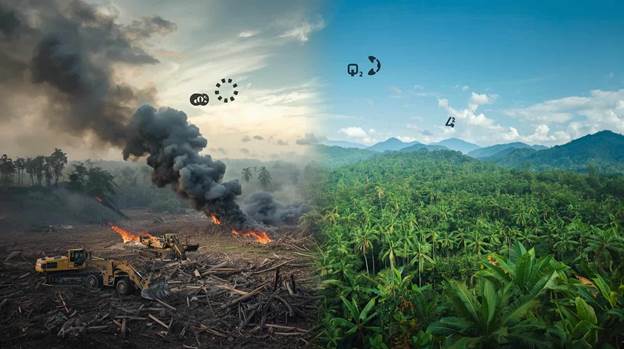
Large-scale deforestation for palm oil plantations has released billions of tons of carbon into the atmosphere, making Indonesia one of the top global emitters.
Africa’s Congo Basin
Deforestation in the Congo Basin is driven by agriculture and fuelwood demand, reducing one of the world’s most vital carbon sinks.
These examples emphasize that managing deforestation is central to effective global carbon emission management.
Challenges in Reducing Emissions from Deforestation
Efforts to reduce deforestation-related emissions face several challenges:
• Economic Pressures: Agriculture, logging, and infrastructure expansion are lucrative industries that drive deforestation.
• Weak Policies: In many nations, policies to protect forests are poorly enforced.
• Global Demand: Rising demand for palm oil, beef, and timber fuels deforestation worldwide.
• Climate Change Feedback: Rising temperatures and prolonged droughts increase vulnerability of forests, worsening the problem.
Overcoming these obstacles requires international cooperation, strong governance, and innovative carbon emission management strategies.
Strategies for Carbon Emission Management Through Forest Protection
Addressing deforestation offers one of the most cost-effective ways to manage carbon emissions. Proven strategies include:
- Reforestation and Afforestation: Planting trees to restore lost forests and create new carbon sinks.
- Sustainable Agriculture: Encouraging eco-friendly farming practices to reduce the need for deforestation.
- Carbon Trading Programs: Offering financial incentives to preserve forests through carbon credits.
- Community-Based Forest Management: Involving local populations in conservation to align economic and environmental goals.
- International Agreements: Strengthening global initiatives like REDD+ (Reducing Emissions from Deforestation and Forest Degradation).
These solutions prove that integrating forest conservation into carbon emission management is both practical and essential.
Future Outlook: Deforestation and Global Emissions
If deforestation continues, global warming may surpass the 1.5°C Paris Agreement limit. Proactive carbon emission management through forest conservation can cut billions of tons of emissions, protect biodiversity, and strengthen climate resilience.
Conclusion
Forests act as natural climate regulators, but when destroyed, they transform from carbon sinks into carbon sources. The consequences reach far beyond the environment, affecting economies, food security, and global stability. By investing in reforestation, sustainable practices, and international cooperation, the world can curb emissions and protect future generations. Effective carbon emission management depends on making forests a priority today.
Q1: How does deforestation contribute to carbon emissions?
Deforestation releases stored carbon from trees and reduces the planet’s ability to absorb carbon dioxide, worsening climate change.
Q2: Which countries face the highest deforestation-related emissions?
Brazil, Indonesia, and regions in Central Africa face the largest emissions due to deforestation.
Q3: How can carbon emission management reduce deforestation impacts?
By promoting reforestation, sustainable farming, carbon credits, and community-based forest protection, emissions from deforestation can be significantly reduced.