
Understanding Tidal Waves and Their True Nature
Tidal waves, often confused with tsunamis, are powerful oceanic waves primarily caused by underwater seismic activity. When tectonic plates beneath the ocean floor shift abruptly, massive energy is released into the surrounding water, displacing vast volumes and generating waves that can travel thousands of kilometers.
Table of Contents
This article explores how underwater earthquakes, volcanic eruptions, and tectonic movements contribute to tidal wave formation, their devastating impact on coastal regions, and the importance of monitoring seismic zones for early warnings.
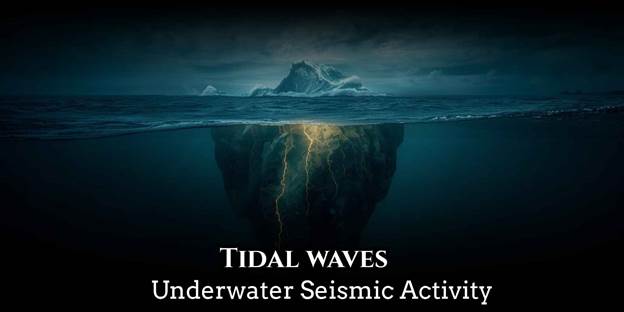
The Science Behind Tidal Waves
Defining Tidal Waves and Seismic Energy
A tidal wave is a large ocean wave usually triggered by underwater seismic disturbances rather than actual tides. These disturbances occur when the Earth’s crust experiences a sudden release of energy, typically due to tectonic plate movements.
- Tectonic plates: massive slabs of Earth’s lithosphere that move slowly but can cause sudden earthquakes.
- Seismic energy: the force that drives the creation of underwater shockwaves.
This energy displaces water vertically, creating a ripple that grows into a massive tidal wave once it travels across the ocean.
How Underwater Seismic Activity Generates Tidal Waves
The Role of Earthquakes Beneath the Ocean
Most tidal waves originate from underwater earthquakes, particularly in subduction zones where one tectonic plate slides beneath another. When the seafloor shifts upward or downward, it pushes water above it, initiating a wave that radiates outward in all directions.
For example:
- The 2004 Indian Ocean tsunami was triggered by a 9.1 magnitude earthquake off Sumatra, causing waves over 30 meters high and affecting 14 countries.
- The 2011 Japan tsunami followed a similar pattern, where the Pacific Plate’s subduction caused widespread destruction.
Volcanic Eruptions and Submarine Landslides
Underwater volcanic eruptions and landslides can also displace large amounts of seawater, producing secondary tidal waves. When magma chambers explode or collapse, the resulting water displacement triggers sudden, localized waves.
Real-world example:
- The Krakatoa eruption in 1883 generated waves up to 40 meters high, killing more than 36,000 people in coastal Indonesia.
Such events demonstrate how seismic and volcanic forces together amplify the intensity of tidal waves.
Hydrodynamic Behavior and Energy Transfer
Wave Propagation Across Ocean Basins
Once a tidal wave is generated, it moves at jetliner speeds sometimes up to 800 km/h. In deep water, its height may only measure a few centimeters, making it nearly invisible. As it approaches shallow coastal regions, wave energy compresses, dramatically increasing height and destructive potential.
Key factors influencing wave behavior:
- Depth of the ocean floor
- Seafloor topography (underwater hills and valleys)
- Distance from the seismic source
Monitoring and Predicting Tidal Waves
The Role of Seismic and Oceanographic Technology
Modern technology plays a vital role in tracking underwater seismic activity to predict tidal waves.
Important tools include:
- Seismographs: detect early ground movement.
- DART buoys (Deep-ocean Assessment and Reporting of Tsunamis): measure sea-level changes in real time.
- Satellite systems: provide instant data to forecasting centers worldwide.
Countries like Japan and the United States have integrated these systems into national early-warning networks, saving countless lives.
Environmental and Human Impacts
Effects on Coastal Ecosystems
When tidal waves strike, the ecological balance of coastal and marine systems suffers immensely.
Consequences include:
- Coastal erosion and habitat destruction
- Contamination of freshwater sources with saltwater
- Long-term disruption to marine biodiversity
These natural disasters highlight the connection between earth science and environmental sustainability.
Human and Infrastructural Damage
Tidal waves not only devastate ecosystems but also cause extensive human and economic losses. Urban coastal areas face:
- Loss of lives and displacement
- Destruction of homes and transport systems
- Economic losses in tourism and fisheries
The rebuilding process after such events often takes years and requires global cooperation.

Real-World Case Studies of Tidal Waves
Case Study 1: The 2004 Indian Ocean Tsunami
This disaster remains one of the deadliest tidal wave events in recorded history. Triggered by a powerful underwater earthquake, it killed nearly 230,000 people.
Case Study 2: The 2018 Sulawesi Event
A rare combination of an underwater earthquake and landslide created devastating tidal waves that struck Palu, Indonesia, within minutes demonstrating the unpredictability of seismic triggers.
Global Preparedness and Mitigation Strategies
How Nations Are Responding
Countries have enhanced preparedness through:
- Seismic hazard mapping
- Building tsunami-resistant infrastructure
- Public awareness campaigns and evacuation training
The integration of artificial intelligence and machine learning in wave prediction has improved early detection accuracy, significantly reducing fatalities.
Conclusion
Tidal waves caused by underwater seismic activity illustrate the immense power of Earth’s internal dynamics. Understanding the mechanisms behind these waves is crucial for developing reliable prediction systems and minimizing damage to coastal communities. Through scientific research, advanced monitoring technology, and international collaboration, humanity can better prepare for and adapt to these natural forces. Staying informed about tidal wave activity and supporting sustainable coastal management are essential steps toward a safer, more resilient future.
1. What causes tidal waves?
Tidal waves are primarily caused by underwater seismic activity, including earthquakes, volcanic eruptions, or landslides.
2. Are tidal waves the same as tsunamis?
Not exactly. While both are large ocean waves, tidal waves result from seismic events, whereas tides are driven by the gravitational pull of the moon and sun.
3. How can tidal waves be detected early?
Through seismographs, DART buoys, and satellite systems that monitor seismic and sea-level data in real time.