
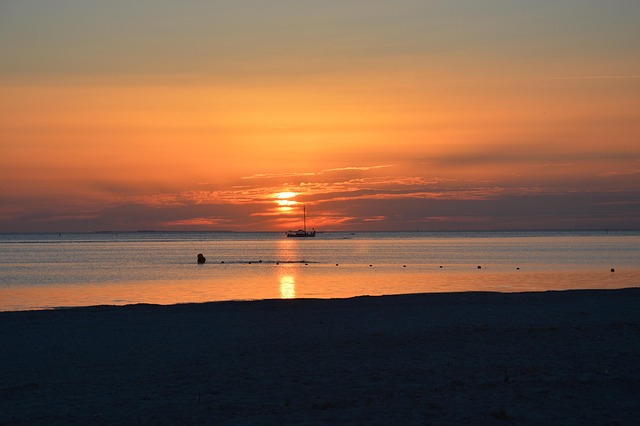
Among nature’s rare spectacles, few inspire as much fascination as the mysterious green flash. For centuries, people across the globe have spoken of a brief emerald gleam that appears at the horizon just as the sun sets or rises. To some, it feels like magic; to others, it is an atmospheric puzzle solved by science. So, what is the green flash at sunset, and why do only a few lucky people witness it? Let’s uncover the science, myths, and beauty behind this fleeting glow.
The Science Behind the Green Flash
To truly answer what is the green flash at sunset, we must start with the behavior of light. The sunlight we see is actually made up of many colors. As the sun lowers toward the horizon, its light passes through a thicker layer of atmosphere compared to when it is overhead. During this journey, the light bends, or refracts, and the colors separate in a process known as dispersion.
Normally, this splitting of light isn’t noticeable. But at sunrise or sunset, the separation becomes more pronounced. The very last part of the sun’s disk can sometimes show a short-lived green edge, visible just before it disappears. That fleeting green glow is what we call the green flash.
Why Green and Not Blue or Violet?
A common question after asking what is the green flash at sunset is: why green?“The explanation comes from the way Earth’s atmosphere bends and scatters sunlight.”Shorter wavelengths, like blue and violet, scatter more easily, which is why the sky looks blue during the day. By the time the sun is setting, much of this blue and violet light is already dispersed and invisible. Green, however, survives long enough to shine briefly before fading, making it the most visible color.
Ideal Conditions for Seeing It
The green flash is elusive because it requires perfect conditions. To have the best chance of spotting it, you need:
- An Open Horizon – Watching over the sea, a desert, or flat plains gives the clearest view.
- Stable Air – Calm, layered air prevents light from distorting.
- Low Pollution and Dust – Clean skies allow the green light to stand out.
- Dry Conditions – Excess humidity can blur or dim the flash.
That’s why many sightings occur at sea or in places with exceptionally clear skies.
Variations of the Green Flash
When people ask what is the green flash at sunset, they often imagine one single effect. In reality, there are several variations:
- Inferior Mirage Flash: A simple version, seen at the horizon.
- Mock Mirage Flash: Caused by unusual atmospheric layers with different temperatures.
- Sub-duct Flash: A slightly longer-lasting flash, often making the sun look flattened.
- Green Ray: The rarest form, appearing as a ray of emerald light shooting upward.
These variations highlight how complex and fascinating the atmosphere can be.
Stories and Legends
Long before scientists explained what is the green flash at sunset, it was wrapped in folklore. Sailors believed seeing it promised safe journeys. Some cultures thought it represented truth, purity, or even luck in love. French writer Jules Verne popularized it in his novel The Green Ray, describing it as a symbol of clarity and enlightenment. Even today, the phenomenon is celebrated in books, films, and travel experiences.
Why It’s Rarely Seen
If you’ve spent countless evenings watching the horizon without spotting it, you’re not alone. “The appearance of the green flash at sunset is tied to a rare balance of environmental conditions.”. Even the slightest haze, turbulence, or misalignment can make it vanish. On top of that, the event lasts just a second or two making it easy to miss if you look away. This rarity only adds to its allure.
How to Improve Your Chances
For those determined to witness this wonder, here are a few tips:
- Find the Right Spot: Coastlines with uninterrupted views are ideal.
- Be Consistent: Watch many sunsets only a few will offer the right conditions.
- Use Binoculars Cautiously: Only when the sun is very close to the horizon, never when it’s high and bright.
- Try Photography: Modern cameras can sometimes capture what eyes overlook.
With persistence, you may one day answer for yourself what is the green flash at sunset—by seeing it with your own eyes.
Conclusion
Science gives us a clear explanation of what is the green flash at sunset: it’s a brief burst of green light, created by atmospheric refraction and the separation of colors in sunlight. But beyond physics, it is also a symbol of nature’s hidden wonders rare, unpredictable, and unforgettable.
If you’re fortunate enough to see it, you’ll understand why so many chase this fleeting emerald sparkle across the horizon.