The urgent question of how to save coral reefs from bleaching has become the defining challenge for marine conservation scientists as unprecedented thermal events devastate reef ecosystems across every major ocean basin. With over 90 percent of the Great Barrier Reef showing bleaching damage and Caribbean reef coverage collapsing below 10 percent, the need for advanced intervention strategies has never been more critical. Yet most environmental content recycles the same generic advice while ignoring the groundbreaking restoration science, genomic research, and bioengineering innovations emerging from leading marine laboratories worldwide.
Understanding how to save coral reefs from bleaching requires examining the complex interplay between ocean acidification, zooxanthellae collapse, sea surface temperature anomalies, and anthropogenic nutrient pollution that collectively drive mass bleaching events beyond natural recovery thresholds.
In this comprehensive guide, we will explore assisted gene flow techniques, heat resistant coral breeding programs, marine protected area frameworks, and carbon sequestration strategies that address how to save coral reefs from bleaching at both local and planetary scales. Discovering how to save coral reefs from bleaching demands moving beyond awareness campaigns into actionable, science backed intervention protocols supported by peer reviewed marine ecology research.
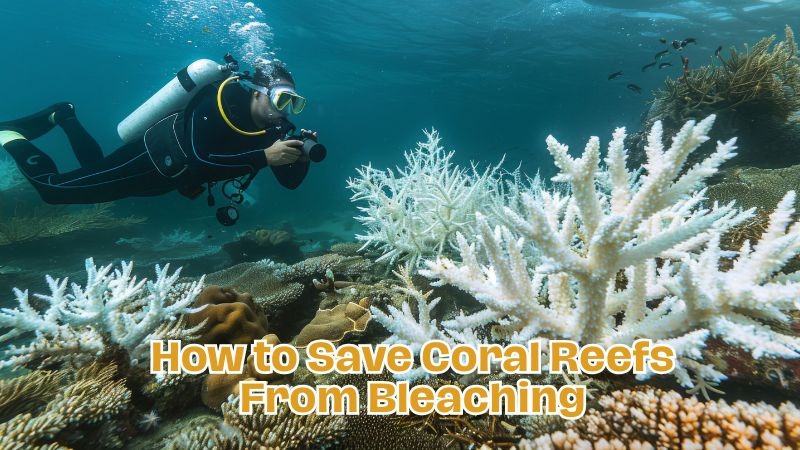
Understanding the Biological Mechanism Behind Coral Bleaching
Before exploring how to save coral reefs from bleaching, it is essential to understand the precise biological process that triggers this devastating phenomenon. Coral polyps rely on a symbiotic partnership with microscopic algae called zooxanthellae that reside within their tissue. These algae perform photosynthesis and supply corals with approximately 90 percent of their energy requirements while giving reefs their vibrant coloration.
When sea surface temperatures rise even 1 to 2 degrees Celsius above seasonal norms, corals experience thermal stress that disrupts the photosynthetic chemistry of zooxanthellae. The algae begin producing toxic reactive oxygen species, forcing the coral host to expel them as a survival mechanism. This expulsion leaves the coral skeleton visible through transparent tissue, creating the characteristic white appearance known as bleaching. Without their primary energy source, corals can survive only four to six weeks before starvation and permanent death occur.
The Escalating Timeline of Global Bleaching Events
The history of mass coral bleaching reveals an alarming acceleration pattern. The first globally recognized event struck in 1998, damaging approximately 16 percent of worldwide reef systems. Subsequent events in 2010 and 2016 each surpassed the previous in both intensity and geographic spread. The 2016 event alone killed an estimated 30 percent of Great Barrier Reef corals within months. Marine ecologists tracking these events confirm that recovery intervals between bleaching episodes have shortened from decades to just a few years, leaving insufficient time for damaged reefs to rebuild before the next thermal assault arrives.
Advanced Genetic Intervention Strategies
One of the most promising frontiers in understanding how to save coral reefs from bleaching involves assisted gene flow and selective breeding programs. Researchers at the Australian Institute of Marine Science have identified coral populations in naturally warmer waters that exhibit significantly higher thermal tolerance compared to their counterparts in cooler regions. By crossbreeding these heat resistant strains with vulnerable populations, scientists aim to introduce adaptive genetic traits across broader reef systems.
This approach mimics natural evolutionary processes but accelerates the timeline dramatically. Wild coral adaptation to rising temperatures would require hundreds of generations spanning thousands of years. Assisted gene flow can potentially compress this timeline into decades, buying critical time while broader climate mitigation efforts take effect. Understanding how to save coral reefs from bleaching through genetic science represents one of the most sophisticated conservation strategies currently under development in marine biology.
Coral Probiotics and Microbiome Engineering
A groundbreaking research avenue involves manipulating the coral microbiome to enhance thermal resilience. Scientists at King Abdullah University of Science and Technology have developed beneficial microbial consortiums that when introduced to coral tissue improve the host’s ability to withstand temperature stress. These coral probiotics function similarly to human gut health supplements, strengthening biological defense mechanisms from within the organism rather than altering external environmental conditions.
Marine Protected Area Frameworks and Their Impact
Establishing and enforcing marine protected areas represents a foundational strategy in how to save coral reefs from bleaching at scale. While protected zones cannot directly prevent ocean warming, they eliminate compounding localized stressors including overfishing, destructive trawling, anchor damage, and coastal pollution runoff that weaken coral resilience against thermal events.
Research from the marine sanctuary networks in Palau and Raja Ampat demonstrates that reefs within well managed protected areas recover from bleaching episodes up to three times faster than unprotected reefs exposed to identical thermal stress. This accelerated recovery occurs because healthy fish populations within protected zones maintain algal grazing pressure that prevents smothering overgrowth on damaged corals, allowing new polyp recruitment and skeletal rebuilding to proceed without biological competition.
- Reduction of sedimentation from coastal development that blocks sunlight essential for zooxanthellae photosynthesis and coral energy production within protected marine boundaries
- Elimination of destructive fishing practices including dynamite and cyanide fishing that physically shatter reef architecture and compromise structural integrity needed for post bleaching recovery
- Restriction of nutrient pollution from agricultural runoff that fuels algal blooms competing with damaged corals for substrate space during critical recovery windows
- Protection of herbivorous fish species including parrotfish and surgeonfish that naturally control algal proliferation on reef surfaces, maintaining conditions favorable for coral regeneration
- Preservation of genetic diversity across reef populations by maintaining large interconnected habitat corridors that enable natural larval dispersal and cross population breeding essential for adaptive evolution
These multilayered protective benefits explain why marine sanctuaries remain indispensable in any comprehensive strategy addressing how to save coral reefs from bleaching effectively.
Innovative Restoration Technologies Making a Difference
Beyond protection and genetics, hands on restoration science has advanced remarkably in recent years. Coral gardening programs now cultivate heat tolerant fragments in underwater nurseries before transplanting them onto degraded reef structures. Organizations operating across the Caribbean and Pacific have successfully grown and outplanted millions of coral fragments using this technique, demonstrating that active restoration can supplement natural recovery processes.
How to save coral reefs from bleaching also involves cutting edge bioengineering solutions. Researchers have developed 3D printed calcium carbonate reef structures that provide artificial substrate for coral larval settlement. These engineered foundations mimic natural reef geometry and have shown promising colonization rates in field trials across the Maldives, Bahrain, and the Florida Keys. Electrochemical mineral accretion technology applies low voltage electrical currents to metal structures submerged near reefs, promoting accelerated calcium carbonate deposition that strengthens existing coral skeletons against environmental degradation.

Cloud Brightening and Solar Radiation Management
Australian researchers are testing marine cloud brightening as a localized intervention to reduce thermal stress on vulnerable reef sections. This technology involves spraying ultrafine sea salt particles into low altitude clouds above reef areas to increase their reflectivity. Enhanced cloud albedo reduces the amount of solar radiation reaching the ocean surface below, potentially lowering local sea surface temperatures by up to 0.5 degrees Celsius during critical summer bleaching windows. While still experimental, this geoengineering approach represents one of the most innovative answers to how to save coral reefs from bleaching at regional scales.
Addressing Root Causes Through Carbon Emission Reduction
Every localized intervention addressing how to save coral reefs from bleaching ultimately depends on successfully reducing global greenhouse gas emissions. The Intergovernmental Panel on Climate Change projects that limiting global warming to 1.5 degrees Celsius above preindustrial levels would preserve approximately 10 to 30 percent of existing reef systems. Exceeding 2 degrees Celsius would result in the functional extinction of over 99 percent of tropical coral reefs worldwide.
This stark scientific reality means that carbon emission reduction is not merely one strategy among many but the absolute prerequisite for every other conservation intervention to succeed long term. Transition to renewable energy infrastructure, elimination of fossil fuel subsidies, and implementation of carbon capture technologies represent planetary scale actions without which genetic adaptation, marine protection, and restoration science cannot outpace the rate of oceanic thermal increase.
The Role of Blue Carbon Ecosystems
Protecting and restoring blue carbon ecosystems including mangrove forests, seagrass meadows, and salt marshes provides a dual benefit for reef conservation. These coastal habitats sequester atmospheric carbon at rates up to 40 times greater than terrestrial forests per unit area while simultaneously filtering nutrient pollutants before they reach reef environments. Countries investing in blue carbon protection effectively address how to save coral reefs from bleaching through both climate mitigation and water quality improvement with a single integrated conservation strategy.
Real World Success Stories Providing Hope
Despite the overwhelming scale of the crisis, several case studies demonstrate that determined scientific intervention can produce measurable results. The Coral Triangle Initiative spanning six Southeast Asian nations has established a transnational marine management framework protecting over 5.7 million square kilometers of reef habitat. Collaborative monitoring programs across Indonesia, Philippines, Malaysia, Papua New Guinea, Solomon Islands, and Timor Leste report stabilized reef health indicators in priority conservation zones despite continued regional warming trends.
Conclusion
The scientific community has made remarkable progress in answering how to save coral reefs from bleaching through multifaceted approaches spanning genetic intervention, marine protected area frameworks, and innovative restoration technologies. Throughout this guide, we explored how assisted gene flow programs, coral probiotic engineering, cloud brightening experiments, and 3D printed reef substrates are pushing conservation science beyond traditional boundaries into genuinely transformative territory. From the Coral Triangle Initiative protecting 5.7 million square kilometers to Hawaiian super coral propagation projects, real world successes demonstrate that determined intervention can produce measurable outcomes.
However, every localized strategy ultimately depends on addressing the root cause of rising sea surface temperatures through aggressive global carbon emission reduction. Understanding how to save coral reefs from bleaching means accepting that genetic adaptation, marine sanctuary networks, and bioengineering innovations cannot outpace oceanic warming without simultaneous planetary scale climate action. Only an integrated approach combining blue carbon ecosystem protection, renewable energy transition, and accelerated restoration science offers a realistic pathway to preserving these irreplaceable marine biodiversity hotspots for future generations.