
One fascinating concept that explains this harmony is asymmetrical balance in nature, where elements are arranged unevenly but still create a sense of equilibrium. Nature is a masterful designer, crafting landscapes, ecosystems, and organisms that are visually striking yet subtly balanced. This natural design principle is visible in everything from the branching of trees to the patterns of rivers, wildlife formations, and even flower arrangements.
In this article, we will explore how asymmetry contributes to visual harmony, dynamic ecosystems, and natural stability. Readers will also discover the role of proportion, movement, and contrast in shaping the world around us, uncovering the hidden artistry behind nature’s seemingly chaotic patterns. By understanding these principles, we gain a deeper appreciation for both aesthetics and ecological balance.
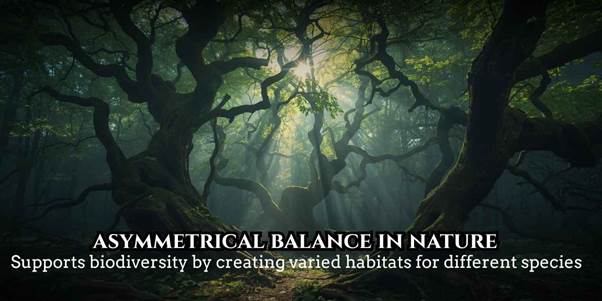
Understanding Asymmetrical Balance in Nature
Asymmetrical balance in nature refers to the arrangement of elements in a way that is not identical on either side, yet still achieves visual harmony and stability. Unlike symmetrical balance, which mirrors elements evenly, asymmetry relies on proportion, contrast, and spatial distribution to create equilibrium. This principle is commonly observed in ecosystems, plant formations, and animal behaviors, demonstrating that balance does not always require exact duplication. By studying these patterns, we gain insight into natural design and aesthetic appeal, helping us appreciate the complexity and intelligence inherent in the natural world.
Historical Background of Asymmetrical Patterns
Humans have observed asymmetry in nature for centuries, recognizing its role in art, architecture, and ecological understanding. Ancient civilizations often drew inspiration from uneven landscapes, animal forms, and plant growth to create visually engaging structures. Early naturalists, including Leonardo da Vinci, documented irregular forms in leaves, shells, and water patterns, highlighting their balance and aesthetic appeal. Over time, scientists have studied these patterns to understand ecosystem stability and species adaptation. The concept of asymmetry in nature is not new, but modern research continues to uncover its significance in biology, environmental science, and even psychology, where humans naturally respond positively to balanced yet varied visuals.
Importance of Asymmetrical Balance in Nature
Asymmetrical balance plays a critical role in maintaining ecological and visual harmony.
Its importance spans multiple dimensions:
• Enhances ecosystem stability by distributing resources and energy unevenly but effectively
• Supports biodiversity by creating varied habitats for different species
• Influences human perception of beauty, making landscapes and natural objects more engaging
• Guides evolutionary adaptations by promoting survival traits in irregular environments
• Provides inspiration for design, architecture, and environmental planning
These aspects show that asymmetry is not just an aesthetic concept but a functional element in natural systems. By understanding its role, we can better protect ecosystems and design spaces that mirror the harmony found in nature.
Benefits of Asymmetrical Balance
The benefits of asymmetrical balance extend beyond visual appeal, impacting ecological, environmental, and human experiences:
• Encourages resilience in ecosystems by distributing pressure and stress unevenly
• Promotes creativity in nature-inspired art and architecture
• Supports natural resource management by optimizing land and water usage
• Improves mental well-being through exposure to visually stimulating and balanced environments
• Inspires sustainable design by showing how irregular structures can be both functional and attractive
By integrating these principles, humans can create urban spaces, gardens, and conservation projects that reflect nature’s efficiency and beauty.

Challenges in Observing and Applying Asymmetry
Despite its advantages, understanding and applying asymmetrical balance can present challenges:
• Complexity in identifying equilibrium without clear symmetry
• Misinterpretation of natural patterns as chaotic or random
• Difficulty in replicating natural asymmetry in human design and architecture
• Balancing aesthetic appeal with ecological function in conservation projects
• Limited awareness of its benefits in education and urban planning
These challenges highlight the need for careful study and observation. Scientists, designers, and conservationists must approach asymmetry with both creativity and analytical rigor to harness its potential.
Real-Life Examples of Asymmetrical Balance
Nature offers countless examples of asymmetrical balance that illustrate its principles:
• Trees and branches that grow unevenly but maintain overall stability
• River systems that twist and diverge, supporting diverse aquatic habitats
• Animal group formations, such as flocks or schools, that adjust dynamically to environmental changes
• Flower arrangements and leaf patterns that use irregular spacing for optimal sunlight absorption
• Coastal landscapes where erosion and deposition create visually balanced yet uneven features
These examples demonstrate that asymmetry is not random but a carefully orchestrated form of natural design. Observing and learning from these patterns can improve both ecological understanding and creative design practices.
Conclusion
In essence, asymmetrical balance in nature reveals how harmony can emerge from diversity and irregularity. It plays a vital role in maintaining ecological stability, inspiring sustainable design, and enhancing visual beauty in our surroundings. From tree growth to flowing rivers, nature demonstrates that perfection is not symmetry but balance through variation. Understanding this concept deepens our appreciation for the natural world’s creative design. To explore further, continue learning about the intricate patterns and principles that shape the beauty of our environment.