Understanding What Is Evapotranspiration
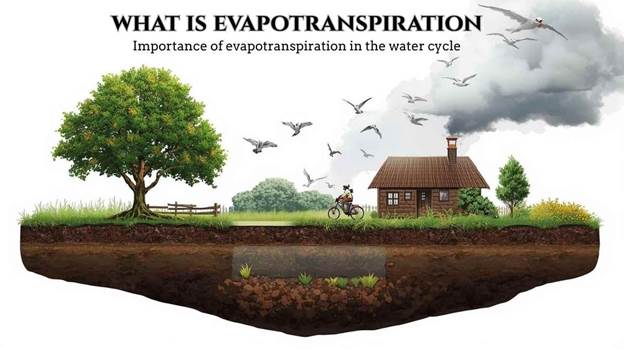
When learning about the Earth’s natural water balance, one common question arises: what is evapotranspiration? Evapotranspiration is a combined process of evaporation and transpiration that plays a crucial role in moving water from the land surface into the atmosphere.
Table of Contents
Evaporation occurs when water from soil, lakes, and rivers turns into vapor, while transpiration happens when plants release water vapor through their leaves. Together, these processes maintain the flow of water within the ecosystem, ensuring that rainfall, soil moisture, and humidity remain in harmony. Understanding this concept helps us appreciate how nature recycles water and sustains life on Earth.
The Science Behind Evapotranspiration
What is evapotranspiration? It serves as a crucial link between the land, plants, and the atmosphere. As part of the hydrological cycle, evapotranspiration connects key stages such as precipitation, infiltration, runoff, and condensation. Scientists measure it using weather data, temperature, solar radiation, and wind speed to determine how much water returns to the atmosphere. In simpler terms, what is evapotranspiration can be understood as a natural pump that transfers moisture from soil and vegetation back into the air. This invisible water movement helps form clouds, regulate temperature, and influence both local and global climates. Regions with dense vegetation like forests and wetlands show high evapotranspiration rates, while arid, barren areas experience much lower levels.
History and Study of Evapotranspiration
The study of evapotranspiration dates back to early hydrologists and botanists in the 19th century who noticed the connection between plant growth and atmospheric moisture. Over time, scientists began developing mathematical models to estimate evapotranspiration rates. Today, modern satellite technology and remote sensing tools allow researchers to measure it globally, helping us understand how ecosystems and agriculture interact with climate.
These advancements are vital for water management, particularly in regions facing drought or water scarcity. Knowing what is evapotranspiration allows environmental planners to make better decisions for irrigation, forest conservation, and urban water planning.
Why Evapotranspiration Matters in the Water Cycle
Evapotranspiration is one of the most critical components of the global water cycle. Without it, the exchange of water between the land and the atmosphere would be incomplete. This process helps:
- Maintain atmospheric humidity which supports cloud formation and rainfall.
- Regulate temperature through cooling effects during transpiration.
- Balance soil moisture levels by controlling how much water evaporates or is absorbed by plants.
- Sustain the hydrological cycle that supports ecosystems, agriculture, and human life.
When evapotranspiration decreases, regions may experience hotter temperatures and less rainfall, leading to dry soil and vegetation stress. This delicate balance shows just how interconnected natural processes are.
Types of Evapotranspiration Processes
To better understand what is evapotranspiration, it helps to know its main types:
- Potential Evapotranspiration (PET): The rate at which water would evaporate and transpire if there were sufficient water available.
- Actual Evapotranspiration (AET): The real amount of water lost through both processes under current conditions.
- Reference Evapotranspiration: Used in agriculture to estimate irrigation needs using specific plant and climate data.
These measurements help scientists, farmers, and environmentalists predict water usage and plan for sustainable agricultural practices.
The Role of Plants in Evapotranspiration
Plants are essential to evapotranspiration. Through their roots, they absorb water from the soil, which travels up to the leaves. When sunlight hits the leaves, tiny pores called stomata open, allowing water vapor to escape into the air. This process not only helps the plant cool down but also contributes significantly to atmospheric moisture.
Forests, grasslands, and wetlands have high evapotranspiration rates due to dense vegetation. Deforestation or replacing natural vegetation with concrete structures reduces evapotranspiration, resulting in urban heat and reduced rainfall.
Benefits of Evapotranspiration to the Environment
Evapotranspiration brings multiple environmental benefits, such as:
- Climate regulation: It moderates temperature by releasing moisture and cooling the air.
- Rainfall formation: The water vapor contributes to cloud formation and precipitation.
- Ecosystem health: Keeps the soil hydrated, ensuring plant and animal survival.
- Water purification: Promotes natural filtration of groundwater through plant and soil interaction.
These benefits emphasize that evapotranspiration is not just a scientific term but a life-sustaining process that affects weather, agriculture, and biodiversity.
Measuring and Monitoring Evapotranspiration
Scientists use various methods to measure evapotranspiration. These include:
- Lysimeters – devices that directly measure the water loss from soil and vegetation.
- Remote sensing – satellites that calculate evapotranspiration using land temperature and vegetation indices.
- Weather-based models – equations such as the Penman-Monteith model that estimate evapotranspiration from meteorological data.
Accurate measurement of evapotranspiration is crucial for irrigation scheduling, drought prediction, and sustainable water resource management.
Challenges and Human Impact on Evapotranspiration
Human activities such as deforestation, industrialization, and urbanization significantly affect evapotranspiration. When trees are cut or replaced with buildings, the surface loses its natural ability to release water vapor. This disruption leads to increased surface temperatures and reduced rainfall.
Real-World Examples of Evapotranspiration in Action
- Amazon Rainforest: Known as the “lungs of the Earth,” this region releases massive amounts of water vapor through evapotranspiration, which contributes to global rainfall patterns.
- Urban Green Spaces: Parks and green roofs in cities enhance evapotranspiration, cooling urban environments and improving air quality.
- Agricultural Lands: Farmers use evapotranspiration data to plan irrigation schedules and prevent water wastage.
These examples highlight how understanding what is evapotranspiration benefits both natural ecosystems and human societies.
Conclusion
Understanding what is evapotranspiration is key to realizing its vital role in the water cycle, where it drives the continuous exchange of moisture between the earth and the atmosphere. From regulating temperature to sustaining rainfall, this natural process maintains the balance that supports all forms of life. By exploring what is evapotranspiration and its importance, we gain a deeper appreciation of how closely we are connected to nature’s water systems.