
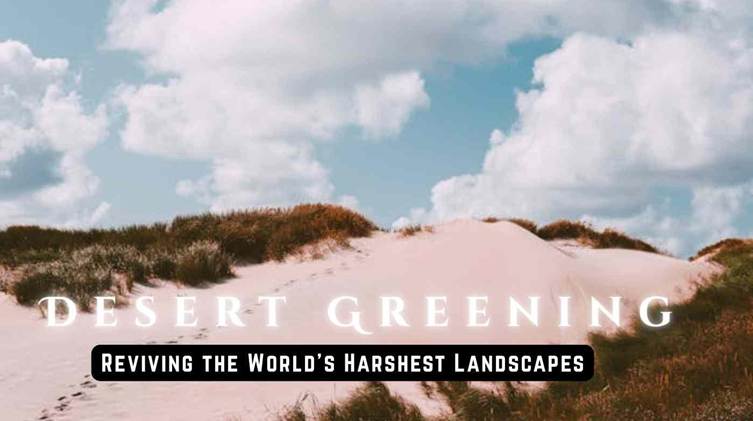
Desert greening is emerging as a revolutionary solution to climate change and land degradation. By transforming arid and barren deserts into productive ecosystems, desert greening not only restores lost biodiversity but also enhances global food security and combats desertification. From using solar-powered irrigation systems to planting drought-resistant vegetation, this innovative approach has the potential to reshape our planet’s most challenging environments.
Table of Contents
This article explores the meaning of desert greening, its history, methods, benefits, challenges, and inspiring global examples that prove how humanity can bring life back to the desert sands.
Understanding Desert Greening and Its Origin
Desert greening refers to the process of converting arid or semi-arid lands into fertile and sustainable ecosystems through technological, biological, and agricultural interventions. It involves improving soil quality, planting native vegetation, and implementing water management techniques.
Historically, desert greening gained global attention during the 20th century when scientists began experimenting with irrigation and sustainable agriculture in desert regions like the Middle East and North Africa. The concept is closely linked to desert reclamation and sustainable land management, aiming to reverse the damage caused by deforestation, overgrazing, and climate change.
The Importance of Desert Greening in Modern Times
As global temperatures rise and fertile lands diminish, desert greening has become crucial for ensuring food security, water conservation, and ecological stability. Restoring deserts into productive lands supports biodiversity and offers hope to nations struggling with drought and land degradation.
Key reasons why desert greening matters:
• It combats desertification, one of the greatest environmental challenges of the 21st century.
• It creates new agricultural opportunities in once-barren regions.
• It helps sequester carbon and reduce atmospheric greenhouse gases.
• It provides sustainable livelihoods to communities living near desert regions.
Techniques and Technologies Driving Desert Greening
Modern desert greening projects combine science, technology, and traditional knowledge. Some of the most effective methods include:
1. Drip Irrigation and Water Recycling
Drip irrigation delivers water directly to plant roots, minimizing waste and maximizing efficiency. Recycling wastewater also ensures that even regions with scarce freshwater resources can sustain plant growth.
2. Use of Solar Energy for Sustainability
Solar power plays a critical role in desert greening, especially in powering irrigation systems and desalination plants. Countries like Saudi Arabia and the UAE use solar farms to generate renewable energy for large-scale greening projects.
3. Planting Drought-Resistant and Native Vegetation
Native species such as acacia, date palms, and salt-tolerant grasses thrive in desert conditions. Their deep root systems stabilize soil, reduce erosion, and retain moisture.
4. Soil Regeneration Techniques
Adding organic compost, using biochar, and integrating microbial inoculants help restore nutrient-poor desert soils, promoting sustainable agriculture.
Global Success Stories of Desert Greening
Real-world examples prove the effectiveness of desert greening when science and determination combine:
China’s Kubuqi Desert
Once a vast desert, the Kubuqi Desert has been transformed through large-scale afforestation, resulting in greener land and improved local economies. The project demonstrates that with consistent effort, desert restoration is achievable.
The Great Green Wall in Africa
Stretching across 8,000 km, the Great Green Wall initiative aims to restore degraded lands across the Sahel region. It has already helped reduce soil erosion and improved the resilience of millions of hectares of land.
Israel’s Negev Desert
Israel’s success story in turning the Negev Desert into a fertile agricultural hub showcases advanced irrigation and solar-powered farming techniques that the world can replicate.
Benefits of Desert Greening for the Planet
Desert greening is not just an environmental solution; it also has economic and social advantages.
• Boosts global food supply and reduces dependence on imports.
• Enhances biodiversity and provides habitats for wildlife.
• Reduces carbon emissions through reforestation.
• Encourages eco-tourism and sustainable livelihoods.
By rejuvenating deserts, nations can address multiple Sustainable Development Goals (SDGs), including climate action, poverty reduction, and ecosystem restoration.

Challenges Facing Desert Greening Efforts
Despite its promise, desert greening faces several obstacles:
• High costs of infrastructure and maintenance.
• Water scarcity in arid regions.
• Soil salinity and poor fertility.
• Climate extremes, such as sandstorms and intense heat.
However, with innovation in biotechnology, renewable energy, and international cooperation, these challenges can be overcome. Governments and environmental organizations are now prioritizing research in climate-resilient agriculture to make greening deserts more feasible and cost-effective.
Future of Desert Greening: Turning Sands into Sustainability
The future of desert greening looks promising with advancements in technology and growing global collaboration. Projects integrating artificial intelligence, remote sensing, and hydrogel-based water retention systems are enhancing the efficiency of greening efforts.
By encouraging eco-friendly agriculture, reforestation, and sustainable water use, humanity is slowly learning how to coexist with nature even in the harshest environments. If supported globally, desert greening could transform the world’s deserts into future agricultural powerhouses.
Conclusion
In conclusion, desert greening symbolizes hope and resilience in the fight against environmental degradation. By transforming dry lands into thriving ecosystems, we can secure food, water, and climate stability for future generations. Investing in desert greening today means investing in a greener, more sustainable planet tomorrow. Let’s continue to support these innovations and move closer to a balanced Earth where even deserts bloom with life.
1. What is desert greening and why is it important?
Desert greening is the process of turning arid or semi-arid lands into fertile ecosystems through sustainable methods like irrigation, reforestation, and soil restoration. It’s important because it helps combat desertification, improves food security, and supports global climate resilience.
2. Which countries have successfully implemented desert greening projects?
Several countries, including China, Israel, and Saudi Arabia, have led successful desert greening initiatives. Notable examples include China’s Kubuqi Desert project, Israel’s Negev Desert farming, and Africa’s Great Green Wall.
3. What are the main challenges in desert greening?
The biggest challenges include water scarcity, high implementation costs, soil salinity, and climate extremes. However, advancements in solar energy, AI irrigation systems, and drought-resistant crops are helping overcome these barriers.