The comparison of dew point vs humidity is key to understanding how moisture interacts with temperature in the atmosphere. Humidity and dew point are closely related concepts that determine how comfortable or sticky the air feels around us.
Table of Contents
This article explores the difference between relative and absolute humidity, their connection with the dew point, and how they affect weather, comfort, and climate monitoring.
What Is Humidity and Why It Matters
Humidity is the measure of the amount of water vapor contained in the air. It plays a vital role in weather prediction, human comfort, and even the functioning of machines and ecosystems. The dew point vs humidity relationship helps meteorologists and scientists understand how saturated the air is at any given time.
There are two major ways to express humidity:
- Relative Humidity (RH): The percentage of water vapor in the air compared to the maximum amount the air can hold at a specific temperature.
- Absolute Humidity (AH): The total mass of water vapor per unit volume of air, regardless of temperature.
Dew Point: The True Measure of Air Moisture
The dew point is the temperature at which air becomes fully saturated, causing water vapor to condense into liquid. Unlike relative humidity, the dew point gives a direct measure of actual moisture content.
- When the dew point is close to the air temperature, humidity is high and the air feels damp or sticky.
- When the dew point is low, the air feels dry and crisp.
For example, a dew point above 20°C (68°F) indicates very humid conditions, while below 10°C (50°F) signals dry air.
Relative Humidity vs Absolute Humidity
Both forms of humidity measure moisture, but they serve different purposes. Understanding their distinction helps interpret weather forecasts and indoor climate conditions more accurately.
Relative Humidity: Temperature-Dependent Comfort
Relative humidity changes with temperature warm air can hold more water vapor than cold air.
When temperature rises and the amount of water vapor stays constant, relative humidity decreases, even though the actual moisture remains the same.
Key facts about relative humidity:
- Expressed as a percentage.
- Influences thermal comfort and perspiration evaporation.
- Commonly used in weather forecasts.
Absolute Humidity: True Moisture Measurement
Absolute humidity represents the actual quantity of water vapor in the air, usually expressed in grams per cubic meter. Unlike RH, it does not depend on temperature.
Absolute humidity is essential for:
- Industrial applications such as food storage or drying processes.
- Scientific research on air composition.
- Understanding water cycles in meteorology.
Dew Point vs Humidity: The Key Relationship
The dew point vs humidity relationship is straightforward yet critical:
- When relative humidity reaches 100%, the air temperature equals the dew point.
- If relative humidity drops, the dew point stays the same, but the air becomes drier.
This relationship between dew point vs humidity explains why summer days often feel so uncomfortable. When the dew point is high, it indicates that the humidity level is also elevated, meaning the air is nearly saturated with moisture. As a result, sweat evaporates less efficiently, making the heat feel much heavier and more oppressive.
How Dew Point, Relative, and Absolute Humidity Interact
These three moisture indicators are interconnected in determining air quality and comfort.
- Dew Point: Indicates how much moisture is in the air.
- Relative Humidity: Shows how close the air is to saturation.
- Absolute Humidity: Quantifies the total moisture present.
For example, two cities can have the same relative humidity but different dew points if one is warmer. The warmer city would actually have more water vapor in the air.

Real-World Applications of Dew Point and Humidity
Understanding dew point vs humidity is vital in several fields:
- Weather Forecasting: Predicts rainfall, fog, and cloud formation.
- HVAC Systems: Controls indoor air quality and comfort.
- Agriculture: Monitors conditions to prevent crop diseases.
- Aviation: Determines visibility and safe flight operations.
- Health: Prevents mold, bacteria growth, and dehydration issues.
Challenges in Measuring Humidity Accurately
Although humidity seems simple, its measurement can be complex.
Challenges include:
- Temperature fluctuations affecting readings.
- Calibration of hygrometers and sensors.
- Variations in atmospheric pressure.
Advanced digital sensors now provide accurate readings for meteorology and industrial applications, reducing the margin of error.
Benefits of Monitoring Dew Point and Humidity
Monitoring dew point vs humidity helps assess air comfort, predict weather changes, and maintain better indoor climate control.
- Comfort Optimization: Helps maintain ideal indoor environments.
- Health Protection: Reduces respiratory and skin problems caused by dry or damp air.
- Energy Efficiency: Optimizes air conditioning and heating systems.
- Environmental Stability: Aids in studying climate patterns and mitigating pollution.
Case Example: Tropical vs Desert Climates
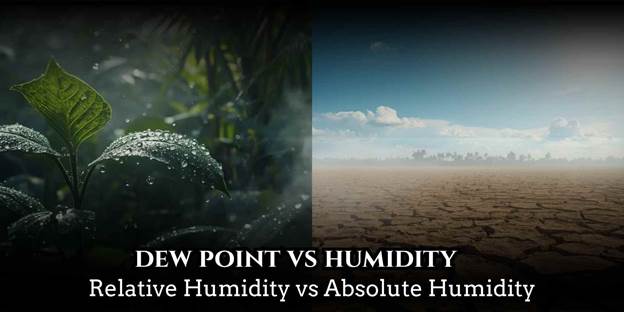
In tropical areas like Southeast Asia, high dew points (above 22°C) create a consistently humid environment. Conversely, desert regions, despite high temperatures, have low dew points and minimal humidity.
This contrast highlights the importance of dew point vs humidity in defining regional climates and living conditions.
Conclusion
Understanding dew point vs humidity along with relative and absolute humidity is essential for interpreting weather conditions, managing comfort, and promoting healthier environments. By measuring both, we gain a full picture of how moisture behaves in the atmosphere. As technology evolves, tracking humidity will continue to play a vital role in climate prediction and human well-being. Stay informed and keep your environment balanced for optimal comfort.
1: What is the main difference between dew point and humidity?
Dew point measures actual moisture content, while humidity indicates how close the air is to saturation.
2: Why is dew point a better comfort indicator?
Dew point directly reflects how much moisture is in the air, influencing how hot or sticky it feels.