Picture standing on a rooftop in New Delhi during crop-burning season. The skyline vanishes behind a wall of gray haze so thick that buildings three blocks away dissolve into ghostly outlines. Schools close. Hospitals overflow with wheezing children. Residents tape wet cloth over their windows hoping to filter what seeps inside. This scene repeats every October and November, and it represents one of the most visible consequences of a crisis that most of the world experiences in less dramatic but equally damaging forms.
Contaminated air does not announce itself with sirens. It accumulates silently in lungs, bloodstreams, and brain tissue over months and years. The World Health Organization places the annual death toll from outdoor air contamination at approximately 4.2 million people, with household pollution from cooking and heating fuels claiming a further 3.8 million. Combined, dirty air kills more humans annually than automobile accidents, armed conflict, and diabetes put together.
Yet this is a solvable problem. Proven solutions to reduce air pollution have already delivered dramatic improvements in cities and nations that committed resources and political resolve to the effort. Not a single strategy on this list is theoretical. Each one carries documented results from real places where air became measurably safer after specific actions were taken.
Table of Contents
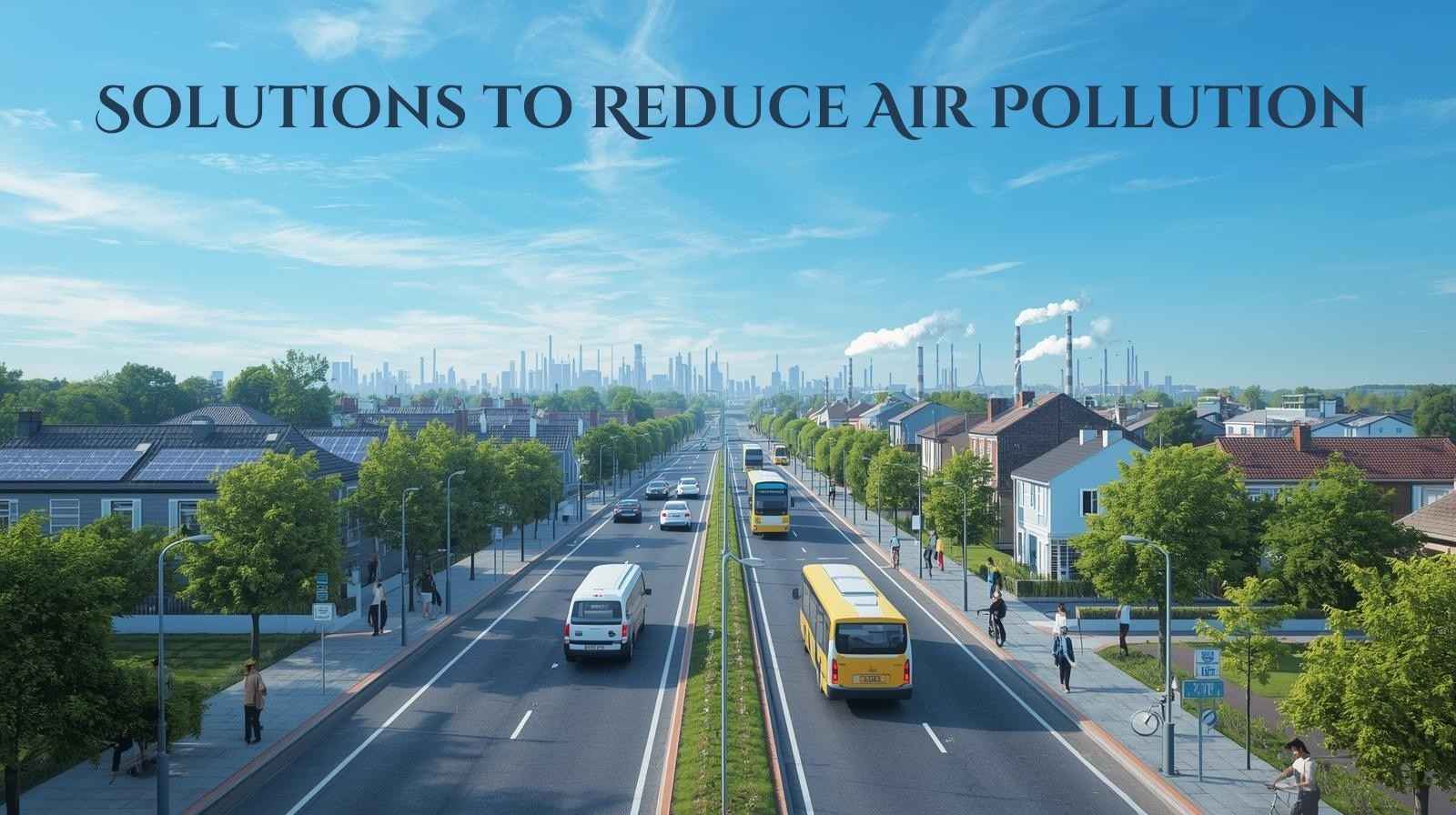
Where Pollution Originates and Solutions to Reduce Air Pollution
Atmospheric contamination happens when harmful substances flood the air faster than weather patterns, rainfall, and natural chemistry can neutralize them. The principal offenders are fine particles measuring less than 2.5 micrometers across, nitrogen dioxide generated wherever fuel ignites at high temperatures, sulfur dioxide escaping coal and petroleum combustion, carbon monoxide from incomplete burning, and ground-level ozone that materializes when vehicle exhaust mingles with intense sunlight.
These substances enter our bodies with every breath and proceed to damage virtually every organ system. Peer-reviewed investigations appearing in journals including The Lancet and the European Respiratory Journal have established firm links between sustained pollution exposure and elevated occurrence of coronary artery disease, ischemic stroke, childhood asthma, gestational complications, cognitive deterioration, and multiple cancer types. This is not speculative health advice. These connections emerge from studies tracking hundreds of thousands of participants across decades.
The financial hemorrhage matches the medical devastation. World Bank economists calculated that pollution-driven health expenses, workforce absences, agricultural yield reductions, and premature mortality drain more than eight trillion dollars from global output annually a figure that dwarfs the investment required to address the problem comprehensively.
1. Redirecting Electricity Generation Toward Emission-Free Sources
Producing electrical power through fossil fuel combustion stands as the single heaviest contributor to atmospheric degradation worldwide. International Energy Agency figures place the energy sector’s share at nearly three-quarters of total heat-trapping gas output, accompanied by enormous sulfur, nitrogen, and particulate discharges.
Harvesting energy from sunlight, moving air, and flowing water generates identical electrical output without igniting anything. Manufacturing costs for these technologies have cratered over the past fifteen years. International Renewable Energy Agency records document a greater-than-ninety-percent price collapse for solar electricity since 2010, positioning clean generation below fossil alternatives in the majority of global markets.
Iceland has operated its national grid on virtually one hundred percent geothermal and hydroelectric power for decades, maintaining affordable rates and pristine air quality simultaneously. On a larger industrial scale, Denmark channeled sustained policy commitment into offshore wind development that now supplies over eighty percent of national electricity, collapsing sulfur emissions by upwards of ninety-five percent across thirty years.
Immediate personal step: Investigate whether your utility offers a renewable tariff option. Many providers now include this at negligible additional expense. Property owners should request solar installation quotes payback timelines have shortened to under eight years in most sunny regions.
2. Rebuilding Urban Mobility Around Clean Alternatives
Automobile exhaust constitutes the most intimate form of air contamination because it discharges directly into the breathing zone of pedestrians, cyclists, schoolchildren walking along roadsides, and residents whose windows face busy corridors. United Nations Environment Programme assessments attribute between one-quarter and one-third of hazardous urban air contamination directly to motor vehicle traffic.
Effective transportation reform requires three simultaneous movements. Battery-powered vehicles must replace combustion engines to eliminate exhaust at the tailpipe. Reliable mass transit networks must absorb trips currently handled by individual automobiles. Street infrastructure must evolve to make cycling and walking genuinely safe and appealing rather than marginally tolerated.
Bogotá, Colombia demonstrates that transformative transit reform does not require wealthy-nation budgets. The city’s TransMilenio bus rapid transit network carries over two million riders daily through dedicated corridors, keeping equivalent numbers of private vehicles off congested roads. In a wealthier context, Norwegian tax policy has pushed electric vehicle market share past eighty percent of new sales, producing documented nitrogen dioxide reductions at urban monitoring stations throughout the country.
Immediate personal step: Commit to handling trips shorter than four kilometers on foot, by bicycle, or via transit for the next thirty days and observe whether the habit takes hold. When vehicle replacement approaches, obtain electric model pricing before assuming conventional remains cheaper.
3. Mandating Industrial Pollution Capture Through Enforceable Standards
Factories, processing plants, and extraction operations concentrate pollution output at identifiable points where intervention proves highly effective — provided regulations compel facility operators to install and maintain capture equipment. Without binding mandates, competitive pressure incentivizes dumping waste gases into communal airspace rather than bearing treatment costs.
Scrubber towers, fabric filter baghouses, electrostatic precipitation units, and closed-loop process redesigns can slash industrial atmospheric discharges by enormous margins. These technologies are commercially mature and widely deployed wherever regulators insist upon their use.
South Korea’s 2019 Special Act on Fine Dust imposed aggressive industrial emission ceilings backed by continuous automated monitoring. National particulate concentrations dropped twelve percent within just two years, demonstrating that regulatory seriousness translates rapidly into atmospheric improvements. Japan’s post-war industrial pollution controls, enacted after devastating public health crises including the Yokkaichi asthma epidemic, transformed Japanese manufacturing into among the cleanest globally while sustaining international competitiveness across every major sector.
Immediate personal step: Research the environmental compliance record of companies whose products you purchase regularly. Support legislative candidates who explicitly advocate binding emission standards with funded enforcement mechanisms.
4. Embedding Living Green Infrastructure Throughout Urban Fabric
Vegetation performs atmospheric cleaning services that no engineered system can replicate at equivalent cost and scale. Leaf surfaces physically intercept airborne particles. Photosynthetic metabolism draws carbon dioxide from surrounding air and releases oxygen. Canopy shading suppresses surface temperatures, inhibiting the photochemical reactions that generate ground-level ozone on hot days.
United States Forest Service researchers led by David Nowak quantified these benefits rigorously, estimating that American urban trees collectively extract roughly seventeen million tonnes of atmospheric contaminants each year, delivering health benefits valued above eighteen billion dollars. This filtration service strengthens annually as trees grow and expand their canopy area.
Medellín, Colombia converted eighteen heavily trafficked roads into interconnected green corridors threaded between neighborhoods, documenting two-degree-Celsius temperature reductions and measurably improved air readings along the transformed routes. Milan’s Bosco Verticale residential towers host over nine hundred trees and twenty thousand smaller plants across their facades, absorbing approximately thirty tonnes of carbon dioxide annually while generating oxygen for surrounding blocks.
Immediate personal step: Plant one native canopy tree in any available ground space this season. If you rent or lack yard access, contribute financially to municipal tree-planting programs or volunteer at community greening events.
5. Eliminating Waste Burning and Reducing Landfill Dependence
Setting garbage ablaze remains tragically prevalent across developing regions and releases an exceptionally hazardous blend of dioxins, furans, black carbon, and vaporized heavy metals. Landfills packed with decomposing organic matter generate methane, which traps atmospheric heat at rates dozens of times more potent than carbon dioxide over twenty-year periods.
Structured recycling channels materials away from destruction. Aerobic composting converts food and garden refuse into useful soil amendment without generating methane. Modern waste-to-energy installations extract power from legitimately unrecyclable remnants while neutralizing toxic emissions through sophisticated multi-stage filtration before any exhaust contacts outdoor air.
Rwanda enacted one of the world’s earliest nationwide bans on single-use plastic bags in 2008. The policy dramatically reduced roadside waste burning and visible litter, earning Kigali recognition as one of the cleanest capital cities in Africa. At the opposite end of the technology spectrum, Sweden processes ninety-nine percent of household waste through recycling or energy recovery, sending less than one percent to landfill and actually importing garbage from neighboring countries to operate its treatment infrastructure at capacity.
Immediate personal step: Establish separate bins for recyclable materials at home today. Begin composting fruit and vegetable scraps using a countertop bin or backyard pile. Route batteries, electronics, and chemical products to designated hazardous waste collection points rather than general rubbish.
6. Designing Buildings That Demand Dramatically Less Energy
Structures consume approximately thirty-nine percent of all energy-related carbon output worldwide according to the Global Alliance for Buildings and Construction. Every unnecessary unit of energy a building draws from the grid generates corresponding pollution at a power facility somewhere along the supply chain.
Enhanced wall and roof insulation, high-performance glazing, LED illumination systems, modern heat pump technology, and learning thermostats that adapt to occupancy rhythms can collectively reduce a building’s energy appetite by half or more without diminishing inhabitant comfort. Structures engineered to certified passive house specifications push heating energy requirements down by as much as ninety percent relative to standard construction.
Immediate personal step: Schedule an energy audit for your home through your utility provider — many offer this at no cost. Address whatever the assessment identifies as the largest efficiency gap first, whether that means adding attic insulation, sealing drafty window frames, or replacing aging heating equipment.
7. Establishing Air Quality Legislation With Genuine Enforcement Teeth
Every nation that has achieved substantial air quality improvements shares one common feature: legally binding emission limits backed by monitoring infrastructure and meaningful penalties for violations. Aspirational targets, voluntary pledges, and industry self-governance consistently produce weaker outcomes wherever they have been studied alongside enforceable regulation.
Analysis of the American Clean Air Act published in the Proceedings of the National Academy of Sciences determined that this single legislative framework prevents roughly 230,000 early deaths annually while generating approximately two trillion dollars in health-related economic benefits against compliance expenditures near sixty-five billion dollars. The benefit ratio surpasses thirty to one, making clean air regulation among the highest-return public investments available to any government.
Immediate personal step: Identify upcoming environmental legislation in your jurisdiction and submit public comments during open review periods. Write directly to elected representatives about air quality priorities. Treat pollution policy as a genuine factor in your voting decisions.

8. Organizing Cities So Daily Life Requires Less Driving
The physical arrangement of a city predetermines how much atmospheric contamination its inhabitants generate through routine daily activities. Dispersed suburban layouts connected exclusively by highway networks make private automobile ownership functionally mandatory. Compact districts integrating housing, employment, retail, and education within walking or cycling distance make driving a choice rather than a requirement.
Barcelona reorganized residential block clusters through its superblocks initiative, removing automobile through-traffic from interior streets and reclaiming asphalt for pedestrian plazas, children’s play areas, and planted greenery. Atmospheric monitoring stations within transformed zones recorded nitrogen dioxide declines approaching twenty-five percent. Freiburg, Germany constructed an entire neighborhood called Vauban around car-free principles, connecting residents to the city center via tramway while proving that zero-emission residential design functions practically for thousands of households simultaneously.
Immediate personal step: Attend your next local zoning or planning board meeting and speak in favor of walkable, mixed-use neighborhood design. Push for protected cycling lanes on streets you use regularly.
9. Deploying Sensor Networks and Smart Systems to Pinpoint and Reduce Contamination
Precise identification of where pollution concentrates and what generates it enables targeted action far more effective than broad untargeted measures. Affordable sensor arrays, orbital observation platforms, and machine learning analytical systems now deliver contamination mapping at granularity that traditional monitoring stations could never approach alone.
London implemented its Ultra Low Emission Zone using automated license plate recognition to identify and levy charges on high-polluting vehicles entering central districts. Greater London Authority data documents a forty-four percent reduction in roadside nitrogen dioxide within the zone since the 2019 launch. In sub-Saharan Africa, Nairobi communities partnered with international sensor initiatives to generate neighborhood-level air quality data for the first time, empowering residents with information previously available only at the national monitoring scale.
Immediate personal step: Install a free air quality monitoring application on your phone and consult it before planning outdoor activities. Advocate for sensor installation funding in communities that currently lack localized pollution data.
10. Cultivating Environmental Understanding Through Education and Civic Engagement
Technical solutions and regulatory frameworks achieve their full potential only when supported by a population that understands what pollutes shared air, recognizes the health stakes involved, and actively participates in demanding and sustaining improvements. Knowledge transforms passive residents into engaged advocates whose decisions reinforce systemic change at every level.
Research published in Environmental Science and Policy demonstrated that populations possessing stronger environmental literacy consistently express higher acceptance of protective regulations and greater personal willingness to adopt cleaner daily behaviors. Concrete understanding of health consequences proved substantially more motivating than generalized appeals to ecological preservation.
Immediate personal step: Discuss air quality openly within your household, workplace, and social circles. Forward credible monitoring data to people in your network. Encourage local educational institutions to integrate atmospheric health topics into existing science curricula.
Personal Action Reference Table
| Action | Impact |
|---|---|
| Select a renewable electricity plan | Disconnects your household from fossil fuel emission chains |
| Walk, bike, or ride transit for nearby destinations | Removes the largest individual source of urban air contamination |
| Reduce home energy waste through insulation and efficiency | Shrinks the emissions generated on your behalf at distant power facilities |
| Recycle and compost household waste consistently | Prevents methane generation and eliminates garbage burning toxins |
| Plant and tend trees wherever space allows | Establishes living filtration systems that strengthen over decades |
| Engage politically around air quality regulation | Amplifies personal impact across entire economic sectors simultaneously |
| Check daily air quality readings before outdoor activities | Protects immediate health while building awareness that drives collective action |
Sources Referenced
| Source | Contribution to This Article |
|---|---|
| World Health Organization, 2024 | Global mortality estimates and population exposure statistics |
| International Energy Agency, 2024 | Energy sector share of total greenhouse emissions |
| International Renewable Energy Agency, 2023 | Solar cost reduction data and global capacity growth figures |
| United Nations Environment Programme, 2024 | Transportation share of urban pollution estimates |
| Nowak et al., United States Forest Service, 2019 | Quantification of urban tree pollutant removal and health value |
| Currie et al., Proceedings of the National Academy of Sciences, 2020 | Clean Air Act mortality prevention and economic benefit analysis |
| Zhang et al., Environmental Science and Technology, 2019 | Documented Chinese industrial emission reduction outcomes |
| Greater London Authority, 2024 | Ultra Low Emission Zone nitrogen dioxide monitoring data |
| World Bank, 2022 | Eight-trillion-dollar global economic cost assessment |
| Global Alliance for Buildings and Construction, 2023 | Building sector energy consumption and carbon output share |
| European Environment Agency, 2023 | EU member state premature death reductions under clean air directives |
| Carattini et al., Environmental Science and Policy, 2019 | Environmental literacy and regulatory acceptance research |
| South Korea Ministry of Environment, 2021 | Special Act on Fine Dust implementation and twelve-percent PM reduction |
Frequently Asked Questions
Which single intervention would deliver the greatest global reduction in air contamination? Shifting electricity generation and industrial heating away from fossil fuels toward renewable sources would yield the broadest measurable improvement. Energy production generates close to three-quarters of atmospheric greenhouse contamination and the dominant share of sulfur and nitrogen compounds that damage respiratory health worldwide. Cleaning this one sector cascades benefits through every other area that consumes electric power.
Is individual behavior change genuinely consequential against a problem this large? Personal transportation, energy, and consumption choices carry real collective weight when multiplied across millions of households. However, peer-reviewed evidence consistently identifies political engagement — supporting enforceable emission legislation, voting for candidates who prioritize atmospheric health, participating in regulatory comment processes — as the individual action with the highest systemic multiplication factor.
How rapidly do atmospheric conditions improve once emission sources are eliminated? Certain pollutants respond almost immediately. Orbital sensors detected twenty-to-forty-percent nitrogen dioxide reductions above major population centers within days of widespread traffic decreases during movement restrictions in early 2020. Fine particulate levels typically adjust over weeks to months following sustained source reductions. Carbon dioxide persists in the atmosphere for centuries, meaning global temperature benefits materialize far more gradually than localized air quality gains.
Can indoor air actually be more contaminated than outdoor air? Frequently, yes. Environmental monitoring has documented indoor pollutant concentrations reaching two to five times the levels measured outdoors at the same location. Cooking processes generate fine particles and nitrogen dioxide. Paints, cleaning agents, and synthetic building materials continuously off-gas volatile organic chemicals. Outdoor contaminants migrate inside through windows and ventilation openings. Adequate fresh air circulation combined with quality particulate filtration addresses the most significant indoor exposure pathways.
Do battery-powered vehicles genuinely improve air quality when electricity generation emissions are included in the calculation? Under virtually all real-world grid conditions, yes. Electric drivetrains produce absolutely zero street-level exhaust, entirely removing the direct respiratory exposure that conventional traffic imposes on pedestrians, cyclists, and roadside inhabitants. Comprehensive lifecycle assessments that include upstream electricity generation emissions consistently demonstrate net contamination reductions compared to equivalent gasoline and diesel vehicles, with the advantage expanding continuously as renewable energy comprises a growing share of electricity supply.
What distinguishes countries achieving rapid air quality gains from those making little progress despite comparable economic resources? Three characteristics consistently separate high performers from laggards regardless of income level. First, air quality targets codified into enforceable law with genuine financial and criminal penalties for violations rather than aspirational guidelines lacking consequences. Second, sustained public investment in atmospheric monitoring infrastructure and accessible clean technology alternatives. Third, broad civic consensus that breathable air constitutes a fundamental shared entitlement requiring collective guardianship rather than a negotiable externality subordinate to short-term economic calculations.