The alarming reality of the amazon rainforest disappearing has escalated from an environmental concern into a full scale planetary emergency that threatens the survival of Earth’s most critical terrestrial ecosystem. Every single minute, vast stretches of irreplaceable tropical forest are being cleared, burned, and converted into agricultural and industrial landscapes permanently. Scientists now warn that certain regions have already crossed ecological tipping points from which natural regeneration may never occur.
This extensively researched article examines amazon rainforest disappearing through advanced deforestation studies analyzing illegal logging operations, agricultural land conversion, climate change driven drought cycles, and the devastating connection between industrial cattle ranching and tropical biodiversity collapse across the entire Amazon basin.
Understanding amazon rainforest disappearing is essential for anyone concerned about global carbon cycle disruption, indigenous community displacement, wildlife habitat destruction, and the long term stability of worldwide weather patterns dependent on Amazonian moisture circulation.
By completing this comprehensive analysis, you will fully grasp why amazon rainforest disappearing represents humanity’s most urgent conservation challenge and what evidence based interventions can still prevent irreversible ecological catastrophe before critical recovery thresholds are permanently surpassed.
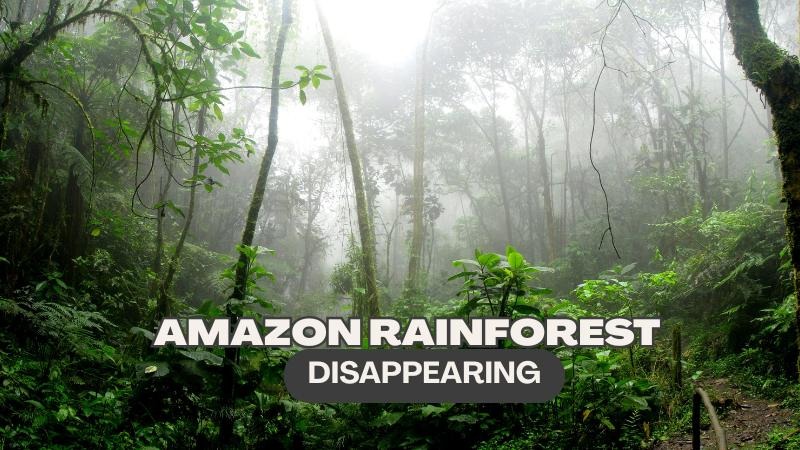
Understanding the Scale and Significance of Amazonian Forest Loss
The amazon rainforest disappearing describes the accelerating destruction of the world’s largest tropical forest ecosystem spanning approximately 5.5 million square kilometers across nine South American nations. This vast wilderness contains an estimated ten percent of all known species on Earth and plays an irreplaceable role in regulating global atmospheric chemistry through massive carbon absorption and oxygen production cycles that sustain life across every continent.
Scientists classify the Amazon as a critical component of Earth’s climate regulation infrastructure because it stores approximately 150 to 200 billion tons of carbon within its vegetation and soils. When deforestation eliminates these forests, stored carbon releases into the atmosphere as carbon dioxide, transforming what was once a carbon sink into a carbon source. Understanding amazon rainforest disappearing requires recognizing that this transformation carries consequences extending far beyond South American borders into every interconnected global weather system.
Historical Background of Amazon Deforestation Patterns
Large scale destruction of the Amazon began during the 1960s when the Brazilian government initiated ambitious infrastructure projects including the Trans Amazonian Highway to encourage settlement and economic development across previously inaccessible interior regions. These policies triggered waves of migration that accelerated illegal logging operations and agricultural land conversion at rates never previously witnessed in tropical ecosystems.
By the 1980s, international satellite monitoring revealed the shocking extent of amazon rainforest disappearing across entire Brazilian states. Environmental advocacy organizations began documenting the crisis, eventually pressuring governments into establishing protected reserves and monitoring programs. Despite these interventions, deforestation rates have fluctuated dramatically depending on political leadership, economic pressures, and enforcement commitment, demonstrating that the amazon rainforest disappearing remains deeply entangled with human governance decisions and industrial economic interests.
How Agricultural Land Conversion Drives Forest Destruction
The single largest driver of amazon rainforest disappearing is the systematic conversion of primary forest into agricultural and pastoral land. Industrial cattle ranching accounts for approximately eighty percent of all deforested areas within the Brazilian Amazon alone. Ranchers clear vast tracts through slash and burn techniques that destroy centuries old ecosystems within days to create grazing pastures for livestock destined for domestic and international beef markets.
Soybean cultivation represents the second most significant agricultural pressure on Amazonian forests. Global demand for animal feed and vegetable oils incentivizes farmers to expand plantations into previously forested regions, particularly along the southern and eastern boundaries of the Amazon basin. This agricultural land conversion creates a frontier of destruction that advances deeper into intact forest each year, fragmenting wildlife habitat destruction zones and isolating species populations from essential genetic exchange corridors.
The Devastating Impact of Illegal Logging Operations
Beyond agricultural expansion, illegal logging operations extract commercially valuable hardwood species from protected and indigenous territories throughout the Amazon basin. Criminal networks exploit weak enforcement infrastructure and corruption to harvest mahogany, cedar, and other premium timber species worth billions of dollars annually on international markets.
Research demonstrates that amazon rainforest disappearing through selective illegal logging degrades forest structure even without complete clearance. Canopy gaps created by extracted trees increase sunlight penetration, drying forest floors and dramatically elevating fire vulnerability during drought periods. This degradation cycle transforms dense primary rainforest into increasingly flammable secondary growth that becomes susceptible to catastrophic wildfire events driven by climate change driven drought cycles intensifying across the region.
Climate Change as an Amplifying Force Against Forest Survival
While direct human activities represent the primary drivers, climate change driven drought cycles increasingly threaten Amazon forest survival independent of deforestation pressures. The Amazon experienced severe drought events in 2005, 2010, 2015, and 2023 that killed millions of trees and released enormous quantities of stored carbon into the atmosphere. These drought episodes are becoming more frequent and intense as rising global temperatures alter precipitation patterns across tropical South America.
Scientists studying rainforest disappearing have identified a potential dieback scenario where progressive drying transforms large portions of dense tropical forest into degraded savanna grassland permanently. This transformation would release tens of billions of tons of carbon, dramatically accelerating global carbon cycle disruption while eliminating the moisture recycling mechanism that generates approximately half of the Amazon’s own rainfall through transpiration from forest canopy surfaces.
Indigenous Community Displacement and Cultural Destruction
The amazon rainforest disappearing carries profound human consequences beyond ecological metrics. An estimated one million indigenous people belonging to over four hundred distinct ethnic groups depend entirely on intact forest ecosystems for their physical survival, cultural identity, and spiritual practices. Deforestation and illegal encroachment into indigenous territories forces communities from ancestral lands they have sustainably managed for thousands of years.
Research consistently demonstrates that indigenous managed territories experience significantly lower deforestation rates compared to surrounding unprotected areas. Recognizing indigenous land rights therefore represents not only a matter of social justice but also one of the most cost effective strategies for preventing amazon rainforest disappearing and preserving tropical biodiversity collapse across the entire basin region.

Critical Challenges Preventing Effective Amazon Conservation
Protecting the remaining Amazon forest requires confronting deeply entrenched systemic obstacles that have undermined conservation efforts despite decades of international attention and investment.
- Powerful agricultural lobbies in Brazil and neighboring nations consistently pressure governments to weaken environmental protections and reduce enforcement funding for monitoring illegal logging operations across protected territories
- International demand for beef, soy, palm oil, and timber creates persistent economic incentives for agricultural land conversion that overwhelm conservation arguments in policy debates
- Climate change driven drought cycles are degrading forest resilience faster than restoration programs can replant and rehabilitate damaged areas across the basin
- Corruption within enforcement agencies enables illegal logging operations and land grabbing to continue with minimal consequences for perpetrators operating across remote regions
- Fragmented international cooperation between the nine Amazonian nations prevents coordinated basin wide strategies necessary to address wildlife habitat destruction and deforestation comprehensively
These interconnected challenges explain why amazon rainforest disappearing continues accelerating despite growing global awareness.
Documented Examples of Catastrophic Forest Loss
The Brazilian state of Mato Grosso provides one of the most devastating examples of rainforest disappearing documented through satellite monitoring. This single state has lost over 140,000 square kilometers of primary forest since systematic clearing began, converting one of Earth’s most biodiverse regions into industrial soybean plantations and cattle ranches stretching across horizons previously dominated by unbroken canopy.
The 2019 Amazon fire crisis captured worldwide attention when over 80,000 fires burned simultaneously across the basin, many deliberately set to clear recently deforested land for agricultural use. This crisis demonstrated how amazon rainforest disappearing through deliberate burning creates international atmospheric pollution events affecting air quality across cities thousands of kilometers from the fire sources.
Why Continued Research and Global Engagement Are Essential
Studying amazon rainforest disappearing serves purposes extending far beyond regional conservation into questions affecting global climate stability, pharmaceutical discovery potential, and worldwide food security. The Amazon contains an estimated 80,000 plant species, many possessing medicinal properties that remain scientifically unexplored and could disappear before discovery if tropical biodiversity collapse continues unchecked.
Satellite monitoring programs, citizen science initiatives, and indigenous partnership networks have expanded data collection capabilities that inform more effective conservation policy recommendations. Every individual who understands why amazon rainforest threatens planetary stability becomes a more powerful advocate for consumer choices, corporate accountability, and governmental policies that protect remaining forest ecosystems. Supporting sustainable sourcing practices, demanding transparency in global supply chains, and funding community based conservation programs represent practical actions that collectively offer humanity its most viable opportunity to preserve the Amazon for future generations before global carbon cycle disruption reaches truly irreversible proportions.
Conclusion
The extensive scientific evidence examined throughout this article confirms that amazon rainforest disappearing represents the most critical ecological crisis threatening planetary stability in our lifetime. From industrial cattle ranching destroying eighty percent of cleared areas to illegal logging operations degrading protected territories, the forces driving destruction remain deeply entrenched within global economic systems that prioritize short term profit over long term survival.
Agricultural land conversion, climate change driven drought cycles, and systematic indigenous community displacement collectively accelerate tropical biodiversity collapse at rates surpassing any previous period in recorded environmental history. The devastating fires of 2019 and catastrophic forest loss across Mato Grosso serve as undeniable warnings that critical recovery thresholds are rapidly approaching.
However, understanding the Amazon rainforest also empowers meaningful action. Supporting indigenous land rights, demanding sustainable supply chain transparency, and funding community based conservation programs represent practical steps every individual can take. Confronting Amazon rainforest disappearing requires urgent global cooperation because preserving this irreplaceable ecosystem ultimately means protecting global carbon cycle stability and the future of biodiversity for generations ahead.