The devastating acceleration of congo rainforest deforestation is silently destroying the world’s second largest tropical forest ecosystem while receiving a fraction of the international attention directed toward Amazonian destruction. Spanning over two million square kilometers across six Central African nations, the Congo Basin harbors extraordinary biodiversity and stores billions of tons of carbon critical for global climate regulation. Yet every year, thousands of square kilometers vanish permanently beneath expanding agricultural frontiers and industrial extraction operations.
This comprehensively researched article investigates congo rainforest deforestation through advanced ecological studies examining illegal timber harvesting, subsistence farming expansion, Central African biodiversity loss, and the alarming connection between mining operations and tropical forest degradation threatening indigenous communities across the entire basin.
Understanding congo rainforest deforestation is essential for anyone concerned about global carbon storage disruption, wildlife habitat fragmentation, climate change acceleration, and the long term ecological stability of Africa’s most vital remaining wilderness regions.
By completing this thorough analysis, you will deeply comprehend why congo rainforest deforestation demands urgent global attention and what scientifically validated conservation strategies can still protect this irreplaceable ecosystem before sustainable recovery limits are permanently exceeded.
Understanding the Congo Basin and Its Global Ecological Importance
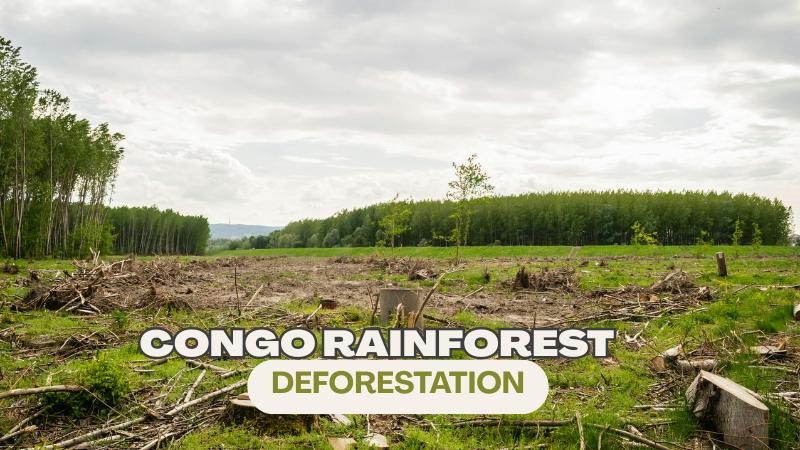
The congo rainforest deforestation crisis involves the systematic destruction of the world’s second largest contiguous tropical forest covering approximately 2.1 million square kilometers across the Democratic Republic of Congo, Republic of Congo, Cameroon, Gabon, Equatorial Guinea, and the Central African Republic. This vast wilderness contains over ten thousand plant species, more than one thousand bird species, and approximately four hundred mammal species including endangered forest elephants, mountain gorillas, and bonobos found nowhere else on Earth.
Scientists regard the Congo Basin as a critical global carbon storage system because its dense vegetation and extensive peatland deposits store an estimated 60 billion tons of carbon beneath its canopy. When congo rainforest deforestation eliminates these forests, massive quantities of stored carbon release into the atmosphere, accelerating climate change acceleration at rates that undermine international emission reduction commitments. Understanding this ecosystem’s significance requires recognizing that its destruction carries consequences reaching far beyond Central African borders into every interconnected global climate system.
Historical Context of Congo Basin Forest Loss
Large scale exploitation of Congo Basin forests began during European colonial occupation in the late nineteenth century when ivory and rubber extraction devastated vast interior regions. However, industrial scale congo rainforest deforestation accelerated dramatically following independence movements across Central African nations during the 1960s as newly formed governments pursued rapid economic development through natural resource extraction.
International logging companies obtained enormous timber concessions throughout the 1980s and 1990s, constructing road networks that opened previously inaccessible forest interiors to settlement and agricultural expansion. These access roads became conduits for wildlife habitat fragmentation as migrating populations established communities along transportation corridors, clearing surrounding forest for subsistence farming expansion that continues expanding deeper into intact wilderness annually. This historical trajectory reveals how congo rainforest deforestation became embedded within complex economic and social systems that resist simple conservation solutions.
How Subsistence Farming Expansion Drives Forest Destruction
Unlike the Amazon where industrial agriculture dominates deforestation patterns, the primary driver of congo rainforest deforestation is small scale subsistence farming expansion practiced by millions of rural households dependent on forest clearance for food production. Slash and burn agriculture, locally known as shifting cultivation, involves clearing small forest plots, farming them for several seasons until soil fertility declines, then moving deeper into intact forest to repeat the cycle.
With Central African populations growing at some of the fastest rates globally, the cumulative impact of millions of individual farming operations creates enormous aggregate forest loss that satellite monitoring systems now track with increasing precision. Research demonstrates that congo rainforest deforestation through subsistence agriculture accounts for approximately seventy percent of total forest clearing across the basin, making poverty reduction and agricultural intensification essential components of any effective conservation strategy.
The Role of Industrial Timber Harvesting
Beyond smallholder agriculture, industrial scale illegal timber harvesting represents a significant driver of tropical forest degradation across commercially valuable regions of the Congo Basin. International demand for hardwood species including sapele, iroko, and African mahogany incentivizes logging companies to harvest trees from protected areas and indigenous territories where enforcement presence remains minimal.
Research confirms that congo rainforest deforestation through selective logging degrades forest canopy structure even when trees are not completely cleared. Heavy machinery compacts soils, logging roads fragment continuous habitat into isolated patches, and canopy gaps increase fire vulnerability during increasingly frequent dry seasons linked to climate change acceleration. This degradation cycle transforms resilient primary rainforest into weakened secondary growth vulnerable to further destruction through subsequent agricultural encroachment and wildfire events.
Mining Operations and Their Devastating Forest Impact
The Congo Basin contains extraordinary mineral wealth including coltan, cobalt, diamonds, gold, and tin that drive extensive mining operations across forested regions. Artisanal and industrial mining activities require clearing forest for extraction sites, processing facilities, access roads, and worker settlements that permanently destroy tropical ecosystems supporting Central African biodiversity loss at alarming rates.
The Democratic Republic of Congo alone supplies approximately seventy percent of global cobalt production, a mineral essential for lithium ion batteries powering smartphones, electric vehicles, and renewable energy storage systems worldwide. This ironic connection between green technology demand and rainforest deforestation highlights the complex relationship between environmental conservation goals and industrial resource extraction pressures that policymakers must navigate carefully.
Impact on Indigenous Communities and Traditional Knowledge
An estimated fifty million people depend directly on Congo Basin forests for their livelihoods, cultural identity, and spiritual practices. Indigenous Pygmy communities including the Mbuti, Baka, and Twa have sustainably managed these forests for thousands of years, developing sophisticated ecological knowledge systems that maintain forest health while providing essential resources for community survival.
It displaces these communities from ancestral territories, destroying irreplaceable traditional knowledge about medicinal plants, sustainable harvesting practices, and ecological management techniques. Studies consistently demonstrate that indigenous managed forest territories experience significantly lower deforestation rates compared to surrounding areas, confirming that supporting indigenous land rights represents one of the most effective and cost efficient approaches to preventing wildlife habitat fragmentation across the entire basin region.
Critical Challenges Confronting Congo Basin Conservation
Protecting remaining Congo Basin forests requires addressing deeply entrenched systemic obstacles that complicate conservation efforts across one of the world’s most politically unstable regions.
- Widespread poverty across Central African nations forces millions of rural households into subsistence farming expansion that collectively destroys thousands of square kilometers of primary forest annually for basic food security
- Armed conflict and political instability across the Democratic Republic of Congo and neighboring nations undermines enforcement of environmental protections and enables illegal timber harvesting within supposedly protected territories
- International demand for minerals, timber, and agricultural commodities creates persistent economic pressures favoring forest clearance over conservation in governmental policy decisions affecting global carbon storage capacity
- Limited scientific monitoring infrastructure prevents accurate tracking of congo rainforest deforestation rates across vast remote regions inaccessible to ground based research teams
- Insufficient international funding for Congo Basin conservation compared to Amazon focused programs leaves critical protection gaps across Africa’s most significant remaining tropical forest ecosystem
These compounding challenges demonstrate why congo rainforest deforestation continues accelerating despite growing recognition of its global significance.
Documented Evidence of Accelerating Forest Loss
Satellite data from the University of Maryland’s Global Forest Watch program reveals that the Democratic Republic of Congo lost approximately 490,000 hectares of primary forest during 2022 alone, ranking it among the highest deforestation rates recorded globally. This devastating loss primarily occurred along the expanding agricultural frontier surrounding major population centers in eastern and central provinces.
The Cuvette Centrale peatland complex, the world’s largest tropical peatland system spanning 145,000 square kilometers, faces growing threats from logging concessions and agricultural encroachment. This single ecosystem stores approximately 30 billion tons of carbon, equivalent to three years of total global fossil fuel emissions. Congo rainforest deforestation threatening this peatland system could trigger climate change acceleration of catastrophic proportions if these carbon reserves are released through drainage and burning activities already documented at the peatland margins.

Why International Attention and Investment Are Urgently Needed
Studying rainforest deforestation serves purposes extending far beyond regional conservation into questions affecting global climate stability, pharmaceutical discovery potential, and worldwide food security. The Congo Basin’s extraordinary Central African biodiversity loss threatens species and ecological relationships that science has barely begun to document and understand.
Expanded satellite monitoring programs, community based conservation partnerships, and sustainable livelihood initiatives have demonstrated measurable success in reducing tropical forest degradation within targeted intervention zones. Every individual who understands why rainforest deforestation threatens planetary stability becomes a more effective advocate for fair trade practices, responsible mineral sourcing, and increased international conservation funding that can protect this irreplaceable ecosystem for future generations before global carbon storage capacity is diminished beyond recovery.
Conclusion
The comprehensive scientific evidence examined throughout this article confirms that congo rainforest deforestation represents one of the most underrecognized yet consequential ecological crises threatening global environmental stability today. From subsistence farming expansion destroying seventy percent of cleared areas to illegal timber harvesting degrading protected territories, the forces driving destruction remain deeply embedded within poverty, political instability, and international commodity demand systems.
Mining operations, climate change acceleration, and systematic indigenous community displacement collectively intensify Central African biodiversity loss and wildlife habitat fragmentation at rates surpassing any previous period in the region’s recorded environmental history. The staggering 490,000 hectares lost during 2022 and growing threats to the Cuvette Centrale peatland system serve as undeniable warnings that critical thresholds are rapidly approaching.
However, understanding congo rainforest deforestation also reveals actionable pathways toward meaningful preservation. Supporting indigenous land rights, demanding responsible mineral sourcing, and increasing international conservation funding represent essential steps. Addressing congo rainforest deforestation requires urgent global cooperation because protecting this irreplaceable ecosystem ultimately means safeguarding global carbon storage capacity and preserving biodiversity for future generations worldwide.