Table of Contents
What Makes Dragonfly Flight So Remarkable?
Dragonfly flight is widely considered the most advanced aerial ability found anywhere in the insect kingdom. These predators can hover, reverse, accelerate sideways, and execute sharp turns that would tear apart most engineered aircraft at equivalent scale. Their flight system has remained largely unchanged for over 300 million years, which tells us evolution perfected this design long before birds or bats ever took to the air.
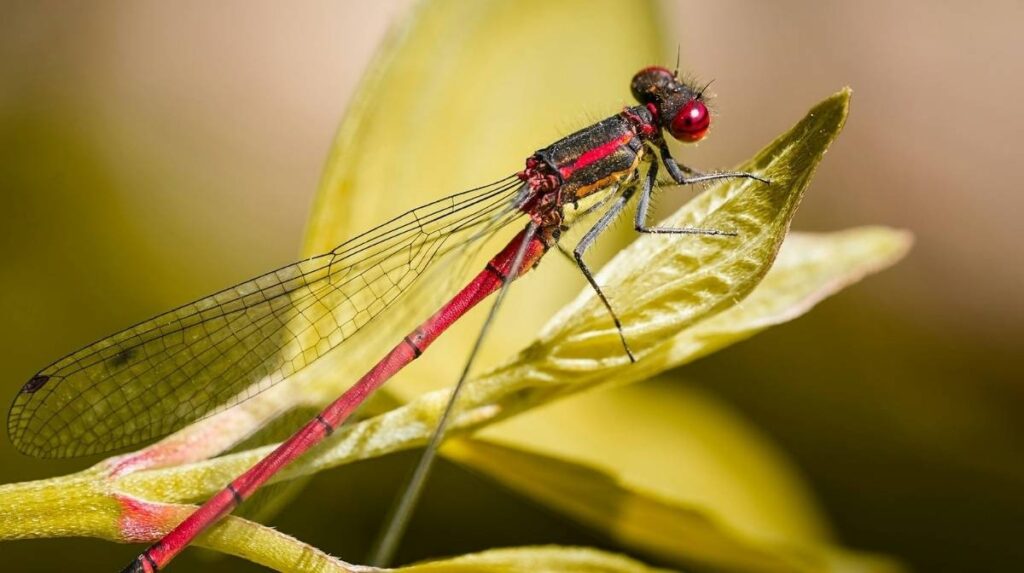
Unlike most flying insects, dragonflies control each of their four wings independently. This gives them a range of motion that no other insect can match. They generate forces of up to 9 G during sharp turns while pursuing prey, matching the performance of modern fighter jets. Wikipedia
How Fast Can Dragonflies Fly?
Large dragonfly species such as hawkers reach top speeds between 22 and 34 miles per hour, with a typical cruising speed around 10 mph. In terms of body lengths per second, dragonflies cover approximately 100 body lengths every second during forward flight, and about three body lengths per second when flying backward. Wikipedia
Some older sources claim speeds of up to 60 mph for certain species like the southern giant darner. However, these claims are considered old and unreliable, and the greatest verified flight speed records actually belong to other insect species. Wikipedia
What makes their speed impressive is not raw velocity but the combination of speed with maneuverability. A dragonfly can go from hovering to full cruising speed almost instantly, then reverse direction without losing control. No helicopter or drone on earth can replicate that transition as smoothly.
The Anatomy Behind Dragonfly Wing Mechanics
Four Independent Wings
The secret of dragonfly performance lies in the architecture of their four wings. Each wing connects directly to powerful muscles at its base, rather than being driven indirectly by the thorax like most other insects. Researchers have identified as many as 71 muscles in the dragonfly thorax, many of which insert directly on the radial veins of the wings, giving active control over angle of attack, camber, twist, amplitude, and frequency for each wing independently. PubMed Central
This direct muscle connection means every wing can operate on its own timing and angle. A dragonfly might push one pair of wings down while pulling the other pair up, or it might stop two wings entirely while the remaining two generate thrust.
The Pterostigma: A Tiny Weight with a Big Job
If you look closely at a dragonfly wing, you will notice a small, darkened cell near the tip called the pterostigma. This tiny structure acts as a counterweight that stabilizes the wing during high speed gliding. Research shows the pterostigma reduces the amount of wing movement needed during gliding by approximately 30 percent. Chester County
Without this small weighted cell, the ultra thin wing membrane would vibrate uncontrollably at speed, making sustained gliding impossible.
Corrugated Wing Surfaces
Dragonfly wings are not smooth like airplane wings. They feature a corrugated surface that might look primitive but actually delivers superior aerodynamic performance. These corrugations create low pressure vortices in the micro valleys between ridges, which increase lift, reduce drag, and allow the wing to operate at higher angles of attack before stalling. Norton Rose Fulbright
The wing membrane itself is astonishingly thin. Dragonfly wing membranes average less than one tenth of the thickness of a human hair, yet they are reinforced by a network of veins made from a composite material containing chitin microfibrils embedded in a protein matrix. Norton Rose Fulbright The outer layers are stiff for load bearing, while the inner layers contain resilin, a springy protein that dampens vibrations.
How Do Dragonflies Hover and Fly Backward?
Dragonflies hover by adjusting the stroke angle and speed of each wing to produce equal upward and forward forces that cancel out all net movement. Their wings beat at roughly 30 cycles per second during hovering, which translates to approximately 1,800 beats per minute.
Flying backward requires a different technique. The dragonfly reverses the pitch of its wing strokes so that thrust is directed forward relative to its body, pushing it in reverse. Backward flight is considerably slower than forward flight, achieving only about three body lengths per second compared to 100 body lengths per second going forward. Pets on Mom.com The rear wings, being larger, are optimized for forward propulsion, which is why reverse speed is limited.
Multiple Lift Generation Methods
What truly sets dragonfly aerodynamics apart is the variety of mechanisms they use to stay aloft. Dragonflies generate lift in at least four different ways at various points during flight, including classical lift similar to an aircraft wing, supercritical lift at angles above the critical stall point using very short strokes, and vortex creation and shedding techniques. Wikipedia
No single principle of aerodynamics explains dragonfly. They switch between methods depending on whether they are hovering, cruising, chasing prey, or gliding.
Dragonfly Hunting and Predatory Flight
Dragonflies are among the most efficient predators on Earth. Studies suggest their hunting success rate exceeds 90 percent, far higher than apex predators like lions or sharks. This success comes down to their extraordinary flight control combined with exceptional vision.
Motion Camouflage in Aerial Pursuit
During predatory attacks and territorial disputes, dragonflies employ a strategy known as motion camouflage, adjusting their flight path so they appear stationary to the target. Wikipedia By maintaining a constant bearing angle relative to their prey, they close distance without triggering the escape reflex of the other insect.
This is the same interception strategy used by guided missiles. The dragonfly computes the trajectory in real time using its massive compound eyes, which contain up to 30,000 individual lenses and provide nearly 360 degree vision.
Acceleration During Combat
In territorial battles between males, dragonflies have been documented accelerating at 4 G linearly while adjusting flight paths to outmaneuver rivals. Wikipedia These are extreme forces for any flying creature, and they demand both structural strength in the wings and precise neural control.
Dragonfly Migration: Long Distance Flight Champions
Not all dragonflies stay near their home ponds. Several species undertake astonishing long distance migrations that rival those of birds. The globe skimmer dragonfly (Pantala flavescens) holds the record for the longest insect migration, crossing the Indian Ocean between India and East Africa, a journey spanning thousands of kilometers.
Dragonflies are known to cross oceans by riding prevailing winds at altitudes exceeding 1,000 meters. Norton Rose Fulbright They conserve energy by alternating between powered flight and extended gliding, using the same corrugated wing design that makes their short distance maneuvers so efficient.
Dragonfly Flight vs. Damselfly Flight
Though closely related, dragonflies and damselflies fly very differently. Dragonflies are agile, powerful fliers, while damselflies have a weaker, more fluttery style of flight. Wikipedia
The key differences include wing position at rest (dragonflies hold wings open, damselflies fold them), body build (dragonflies are heavier and more robust), and wing shape (dragonfly hindwings are broader than forewings, while damselfly wings are more symmetrical). These structural differences translate directly into flight capability, with dragonflies being far better suited for high speed pursuit and sustained hovering.
Biomimicry: How Dragonfly Flight Inspires Technology
Engineers and roboticists have studied dragonfly aerodynamics for decades. The four wing independent control system offers a blueprint for micro air vehicles (MAVs) that need to operate in tight spaces or harsh environments.
Researchers have noted that a vehicle with unfolding wings capable of both ascending and gliding would be superior to designs like the Ingenuity Mars helicopter, whose rigid rotors must spin continuously to remain airborne. Norton Rose Fulbright Dragonfly wing corrugations and vein structures are being replicated in composite materials to create lighter, stronger, and more efficient drone wings.
The NASA Dragonfly mission, scheduled for the 2030s, even borrows the name for a rotorcraft lander designed to explore Saturn’s moon Titan, directly acknowledging the insect’s unmatched flight capabilities.
The Evolutionary History of Dragonfly Flight
Dragonflies have been flying for approximately 350 million years, making them one of the earliest winged insects in the fossil record. Ancient relatives known as Meganisoptera grew to wingspans of roughly 70 centimeters, resembling modern dragonflies in many respects including broader hindwings, powerful flight muscles, large mandibles, and spiny predatory legs. PubMed Central
Despite hundreds of millions of years of evolution, the basic flight plan has barely changed. The same four wing independent system, the same direct flight muscles, and the same corrugated wing architecture found in fossils are still present in the 3,000 plus species alive today. When a design works this well, evolution tends to leave it alone.
Conclusion
Dragonfly flight represents one of nature’s most refined engineering achievements. From independent four wing control and multiple lift generation methods to motion camouflage hunting strategies and ocean crossing migration, these insects demonstrate capabilities that modern technology still struggles to replicate. Whether you are a nature enthusiast, a student of biology, or an engineer looking for design inspiration, understanding how dragonflies fly reveals just how much we can learn from 350 million years of aerodynamic evolution.
Next time you see a dragonfly darting over a pond, take a moment to appreciate the extraordinary physics happening in those translucent wings. If this guide helped you understand dragonfly flight better, share it with someone who would enjoy learning about these incredible aerial predators.
How fast can a dragonfly fly?
Most large dragonfly species reach maximum speeds between 22 and 34 miles per hour, with average cruising speeds around 10 mph. While some sources claim speeds up to 60 mph, these figures have not been reliably verified by researchers.Most large dragonfly species reach maximum speeds between 22 and 34 miles per hour, with average cruising speeds around 10 mph. While some sources claim speeds up to 60 mph, these figures have not been reliably verified by researchers.
Can dragonflies fly backward?
Yes, dragonflies are one of the few insects capable of true backward flight. They accomplish this by reversing the pitch of their wing strokes, although backward speed is significantly slower than forward flight, reaching only about three body lengths per second.
Why can dragonflies hover in midair?
Dragonflies hover by independently adjusting the speed, angle, and timing of each of their four wings. This creates balanced forces that hold the insect stationary. Their wings beat at approximately 30 times per second during hovering.
How do dragonfly wings work differently from other insects?
Unlike most insects whose wings are powered indirectly by thorax contractions, dragonfly wings connect directly to flight muscles at their base. Each of the four wings operates independently, allowing the dragonfly to combine different flight modes simultaneously.
What is the pterostigma on a dragonfly wing?
The pterostigma is a small, darkened, weighted cell near the tip of each wing. It acts as a stabilizer that prevents the thin wing membrane from vibrating at high speeds, reducing the energy needed for gliding by roughly 30 percent.
How do dragonflies catch prey while flying?
Dragonflies use a technique called motion camouflage, adjusting their flight trajectory so they appear stationary to the target insect. Combined with compound eyes offering nearly 360 degree vision and the ability to accelerate at 4 G, this makes them exceptionally effective aerial hunters with success rates above 90 percent.